
An AI acceptable use policy is a formal document that defines which AI tools employees may use, what data they may put into them, which tasks require human review, and what is prohibited outright. It sets the rules of engagement for AI at work and assigns accountability when those rules are broken.
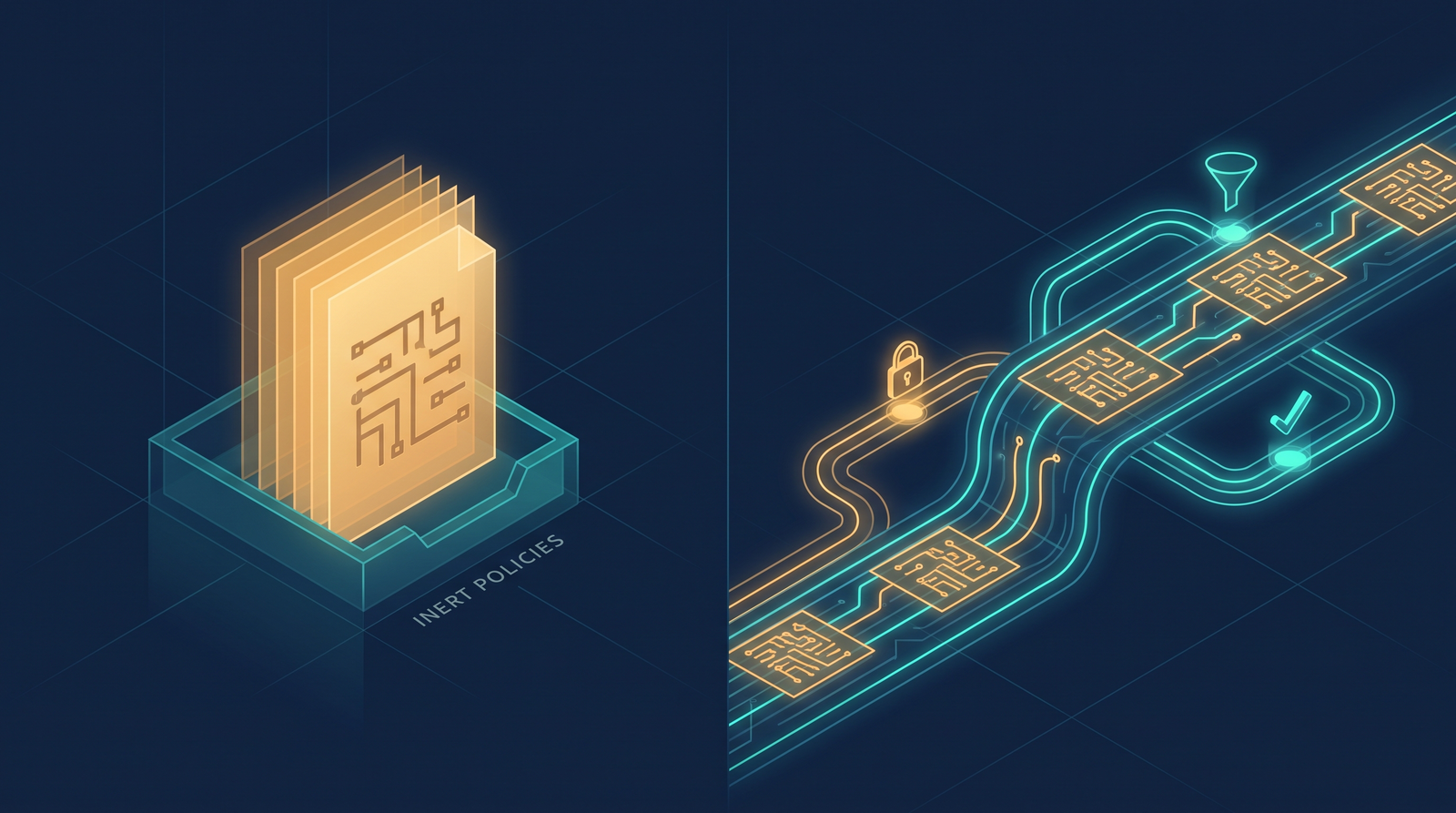
Most organizations already have one. Far fewer can show an auditor that it changed anything. The gap between a policy that exists and a policy that binds is where regulated AI programs get into trouble, and closing it is an architecture problem rather than a drafting problem.
| DOCUMENT | WHAT IT GOVERNS | WHO OWNS IT | HOW IT IS ENFORCED |
|---|---|---|---|
| AI acceptable use policy | Employee behavior: approved tools, permitted data, required review | Legal and IT | Training, attestation, monitoring, disciplinary action |
| AI governance framework | The whole program: risk tiers, roles, controls, evidence | Risk and compliance | Committee review, internal audit, external assurance |
| Data classification policy | What data is sensitive and where it is allowed to travel | Information security | Labeling, access controls, data loss prevention |
| Model governance policy | Which models are approved and how they are validated | Model risk and MLOps | Validation gates, approval registers, monitoring |
| Vendor AI terms | What a supplier may do with your data and outputs | Procurement | Contract clauses, audit rights, certification review |
Why most AI acceptable use policies fail
An AI acceptable use policy fails for the same reason most security awareness training fails. It describes behavior the system does not constrain. If the policy says confidential client data must never be pasted into a general purpose model, and nothing in the environment prevents that paste, the policy is a statement of hope with a signature block attached.
The policy describes behavior the system permits anyway
Employees do not read policies at the moment of use. They act in the tool. When the approved path is slower than the unapproved one, the unapproved one wins, which is how shadow AI takes hold inside firms that have a perfectly well written policy on the intranet. Enforcement has to live where the work happens, not in a document management system.
The policy ages faster than the tooling
An AI acceptable use policy written around a named list of approved products is stale within a quarter. Models get replaced, vendors ship agents into existing suites, and a tool that was read only last year now takes actions on the user's behalf. Policies that bind to capabilities and data categories survive; policies that bind to product names do not.
What to include in an AI acceptable use policy
A workable AI acceptable use policy covers six areas. Each one should be written so that a control owner can point to the mechanism that backs it, not just the paragraph that describes it.
Scope and approved tools
State who the policy applies to, including contractors and third parties, and define approval by capability tier rather than by brand. A tier for public general purpose assistants, a tier for enterprise deployments under contract, and a tier for internal systems that touch regulated content will outlast any product list.
Data handling rules
Tie permitted inputs to your existing data classification scheme instead of inventing new categories. Say plainly which classifications may never leave the environment, whether prompts and outputs are retained, and whether any input may be used for vendor model training. This section is where sovereignty commitments become concrete.
Human review and disclosure
Define which outputs require a named human reviewer before they reach a client, a regulator, or a decision that affects a person. Define when AI involvement must be disclosed. Vague language such as "use judgment" gives an examiner nothing to test, so specify the decision types and the reviewer role.
Prohibited uses
List the uses that are never permitted, and align them with law rather than preference. Article 5 of the EU AI Act sets out prohibited practices, with penalties reaching EUR 35 million or 7 percent of total worldwide annual turnover, whichever is higher. A policy that mirrors the statutory prohibitions is easier to defend than one that improvises its own.
Roles, training, and reporting
Name the accountable owner, the escalation path, and the route for reporting a bad output or a near miss. Training is now a legal obligation in some jurisdictions rather than good practice: Article 4 of the EU AI Act requires providers and deployers to ensure a sufficient level of AI literacy among staff operating these systems.
Review cadence and evidence
Set a review interval measured in months, not years, and state what evidence the organization retains: attestations, access logs, review records, and the audit trail behind AI generated content that reached a client. Evidence is the part auditors ask for first and the part most policies never mention.

Turning the AI acceptable use policy into enforced controls
The move that separates a mature program from a paper one is mapping every policy clause to a control that operates without a human remembering to apply it. Access rules become attribute based access control evaluated at the AI layer, so an answer assembled for one user cannot include material that user is not cleared to see. Data residency commitments become deployment topology rather than a promise in a vendor questionnaire.
Sourcing rules work the same way. If the policy says client facing answers must rest on approved material, the system should answer only from approved sources, cite what it used, and drop sentences it cannot source before serving them. Currency rules follow: approved knowledge expires and is pulled from circulation automatically, content hashes surface drift when a source changes underneath an answer, stewards record supersession, and citations carry a stale flag so a reviewer sees the risk instead of discovering it later. That combination is what makes a policy testable. You can read the architecture in more detail on the Sovrinty product page and in our security and sovereignty model.
External frameworks give you the scaffolding for this mapping. The NIST AI Risk Management Framework organizes controls under Govern, Map, Measure and Manage, and ISO/IEC 42001 turns the same logic into a certifiable management system. Neither will write your acceptable use policy, but both tell you what a defensible one has to connect to. The EU AI Act text supplies the obligations that are no longer optional.
What changes in regulated industries
In defense, financial services, and healthcare the acceptable use policy carries more weight because a supervisor will eventually read it next to a sample of actual outputs. Financial institutions have to reconcile it with model risk management expectations. Healthcare organizations have to reconcile it with protected health information rules that predate the technology by decades. Defense programs have to reconcile it with classification and export control regimes where a single unpermitted inference is an incident.
The common requirement across all three is provability. It is not enough to have prohibited a use; you have to be able to demonstrate the prohibition held on a specific date for a specific answer. Gartner forecasts that through 2026, organizations will abandon 60 percent of AI projects unsupported by AI-ready data, and the same underlying weakness, knowledge nobody can vouch for, is what turns a policy into theater. See how this plays out by sector on our solutions pages.
If your AI acceptable use policy is written but you cannot yet produce the evidence that it held, that gap is worth closing before your next examination rather than during it. Book a Sovrinty demo and we will walk through how each clause maps to a control you can show an auditor.
FAQ
Common questions
What is an AI acceptable use policy?
An AI acceptable use policy is a formal document that defines which AI tools employees may use, what data they may enter, which outputs require human review, and which uses are prohibited. It also names the accountable owner and the process for reporting problems.
What should an AI acceptable use policy include?
Six sections: scope and approved tool tiers, data handling rules tied to your classification scheme, human review and disclosure requirements, prohibited uses aligned to law, roles and training obligations, and a review cadence with the evidence you retain.
Is an AI acceptable use policy required by the EU AI Act?
The EU AI Act does not mandate a document with that title, but it does impose obligations that most organizations meet through one, including the Article 4 requirement that providers and deployers ensure sufficient AI literacy among staff, and the Article 5 prohibitions on certain practices.
How is an AI acceptable use policy different from an AI governance framework?
An acceptable use policy governs employee behavior and is usually owned by legal and IT. A governance framework governs the whole program, including risk tiers, control design, and evidence, and is usually owned by risk and compliance. The policy is one artifact inside the framework.
How often should an AI acceptable use policy be reviewed?
Review at least every six months, and immediately on a trigger such as a new model deployment, a new agentic capability in an existing tool, a regulatory change, or an incident. Annual review cycles are too slow for how quickly AI capability changes inside products you already own.
How do you enforce an AI acceptable use policy?
Map each clause to a technical control rather than relying on attestation. Access rules become attribute based access control at the AI layer, residency commitments become deployment topology, and sourcing rules become systems that answer only from approved material, cite it, and retain the record.
Should contractors be covered by the AI acceptable use policy?
Yes. Contractors, temporary staff, and third parties handling your data should be in scope, with the obligations mirrored in contract terms so they are enforceable against the supplier and not only against your own employees.


