
AI data governance is the set of policies, controls, and provenance tracking that determine which data an AI system can use, who can access it, and how every answer traces back to an approved source. It keeps AI outputs grounded in current, permissioned, and auditable data rather than unverified content.
| DIMENSION | TRADITIONAL DATA GOVERNANCE | AI DATA GOVERNANCE |
|---|---|---|
| Primary goal | Accurate reports and regulatory filings | Trustworthy, traceable AI answers |
| Scope | Databases, warehouses, and pipelines | Every source an AI model can read or cite |
| Access control | Role-based on tables and rows | Attribute-based at the AI answer layer |
| Freshness | Periodic data-quality reviews | Sources expire and are pulled automatically |
| Proof | Catalogs and lineage reports | Citations tracing each answer to its source |
| Main failure | A flawed report | A confident but wrong AI answer |
Why AI Data Governance Differs From Traditional Governance
Traditional data governance was built to keep reports accurate and regulators satisfied, on the assumption that a person would read the output and apply judgment. Generative AI removes that human checkpoint. A model assembles a fluent, confident answer from whatever data it can reach, including stale documents, unapproved drafts, and content a given user was never cleared to see. AI data governance closes that gap by governing data at the point the model consumes it, not only where it sits at rest.
The distinction matters because the blast radius is larger. A flawed quarterly report is embarrassing. A flawed AI answer sent to a customer, a regulator, or a frontline clinician can breach a contract, trigger a penalty, or put someone at risk. Governance has to move from the warehouse to the answer.
The Cost of Ungoverned Data in AI
Gartner forecasts that 60 percent of enterprise AI projects will be abandoned through 2026 because organizations lack AI-ready data. The failure is rarely the model itself. It is that the data feeding the model is fragmented, outdated, or impossible to trace, and a business that cannot show where an answer came from cannot defend it.
Three failure patterns recur: stale sources that were correct last year and wrong today; over-permissioned retrieval that surfaces content a user should never see; and unverifiable output that no one can trace to a source of record. Each is a data governance failure wearing an AI costume.
Core Pillars of an AI Data Governance Framework
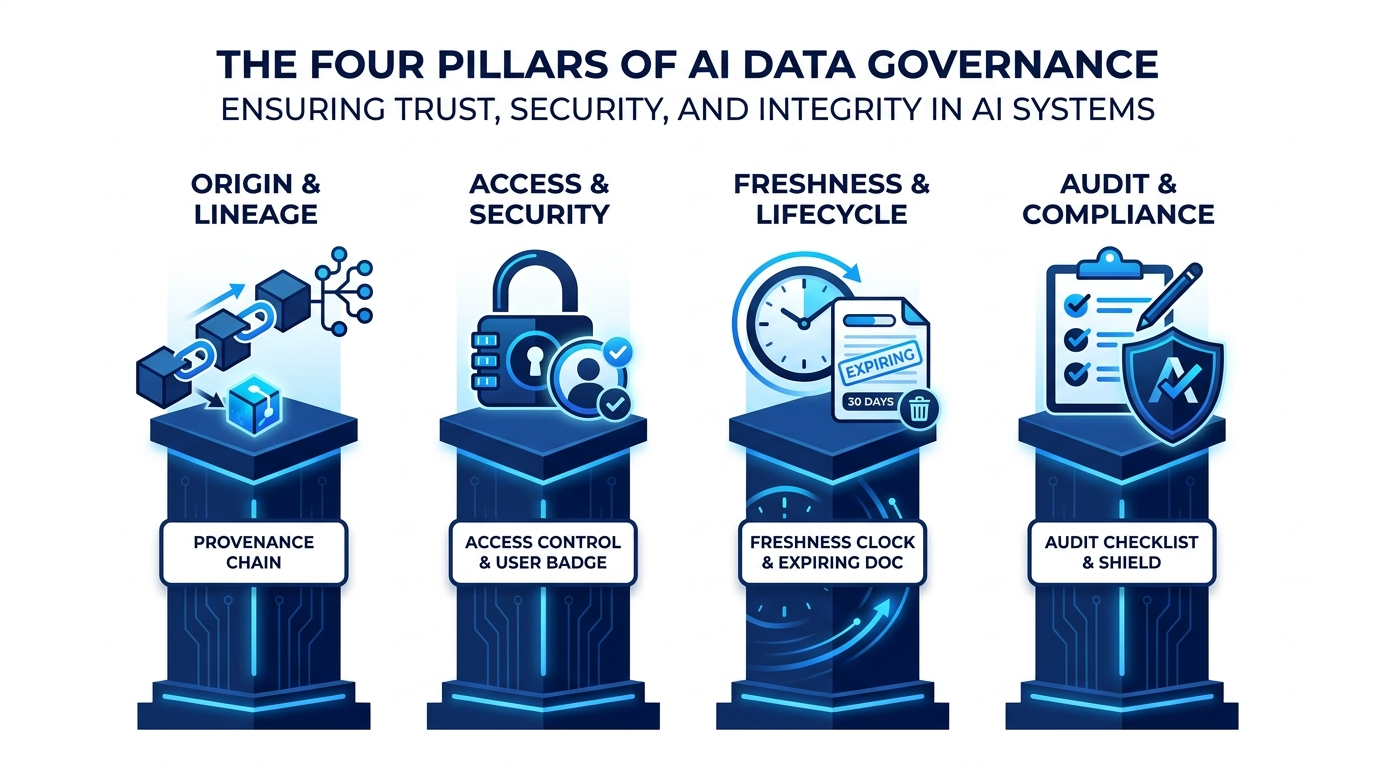
A workable AI data governance framework rests on four pillars. Together they turn the AI said so into here is the approved source, the access rule, and the timestamp behind this answer.
Provenance and traceability
Every answer should carry a citation back to the specific source it came from. Provenance is what lets a compliance team, an auditor, or a customer verify a claim instead of trusting it. Sovrinty treats this as governance by architecture: answers are grounded in approved sources, and unsourced sentences are removed before an answer is served. See how provenance works on the Sovrinty platform.
Access control at the AI layer
Role-based permissions on tables are not enough when a model can synthesize across thousands of documents. Attribute-based access control, applied at the AI layer, evaluates who is asking, what they are cleared for, and the sensitivity of each source before anything is retrieved. Retrieval stays inside the boundaries the user is actually permitted, with no data leaving the environment. More on zero-exfiltration and ABAC.
Freshness and lifecycle
Data that was accurate at ingestion decays. Strong AI data governance gives knowledge a lifecycle: sources carry expiry rules, superseded documents are flagged, and content that ages out is pulled from circulation automatically so the model stops citing it. The aim is knowledge that is current by default and never silently stale.
Auditability and compliance
Every retrieval, permission decision, and citation should be recorded so the organization can reconstruct why the AI said what it said. Audit-ready by design is the difference between passing a regulator's review and scrambling through logs after an incident.
AI Data Governance and Regulatory Compliance

Regulators have made data governance non-optional for AI. The EU AI Act requires data governance, record-keeping, and transparency for high-risk AI systems, with penalties reaching EUR 35 million or 7 percent of global annual turnover. The NIST AI Risk Management Framework similarly centers traceability and documentation. Both assume you can show your work, and AI data governance is how you produce that evidence on demand.
How to Build AI Data Governance Into the Architecture
Bolting governance on after deployment rarely holds. The durable pattern is to make the governed data layer the only path the model can take to an answer, so policy is enforced by the architecture rather than by reviewer goodwill. In practice that means a single approved knowledge layer feeding the model, access decided at query time, sources versioned and dated and expirable, and every answer emitted with its citations attached. Model choice stays flexible; a bring-your-own-model approach keeps the governance layer constant while the underlying model changes.
If your AI answers need to survive an audit, start with the data behind them. See how Sovrinty governs the knowledge layer so every answer is cited, current, and defensible. Request a demo.
FAQ
Common questions
What is AI data governance?
AI data governance is the practice of controlling which data an AI system can access, use, and cite, so that every answer is grounded in approved, current, and traceable sources rather than unverified content.
How is AI data governance different from traditional data governance?
Traditional data governance protects data at rest for reporting and quality, while AI data governance governs data at the moment a model consumes it, adding provenance, access control at the answer layer, and automatic freshness enforcement.
Why do AI projects fail without data governance?
Because ungoverned data produces answers no one can trace or trust. Gartner forecasts that 60 percent of enterprise AI projects will be abandoned through 2026 for lack of AI-ready data, and untraceable answers stall adoption.
Does the EU AI Act require data governance?
Yes. The EU AI Act mandates data governance, record-keeping, and transparency for high-risk AI systems, with penalties of up to EUR 35 million or 7 percent of global annual turnover.
What is ABAC in AI data governance?
Attribute-based access control evaluates the user, their clearances, and each source's sensitivity at query time, so a model retrieves only what the user is permitted to see.
How do you keep AI retrieval data current?
Give sources a lifecycle: set expiry rules, flag superseded documents, and automatically remove aged-out content from circulation so the model stops citing stale sources.


