
An AI governance framework is the set of policies, controls, and evidence mechanisms that govern how an organization builds, deploys, and monitors AI systems. In regulated industries it has to do more than document good intentions. It has to enforce them at the point where AI touches sensitive data, and produce proof that it did. This blueprint breaks down what belongs in a governance framework, why so many stall at the policy stage, and how to map your controls to the standards regulators actually check, including NIST, ISO 42001, and the EU AI Act.
What Is an AI Governance Framework?
An AI governance framework is a structured system of accountability for artificial intelligence. It defines who owns each model, what data that model may use, how decisions are logged, and how the organization detects and corrects failures. Think of it less as a document and more as an operating layer that sits between your AI systems and the people who rely on them.
A useful framework answers four questions on demand: What data produced this answer? Who was allowed to see it? What policy governed the request? And can we prove all of the above after the fact? If your current approach cannot answer those questions for a specific AI output, you have a policy, not a framework.
Why AI Governance Frameworks Fail in Regulated Industries
Gartner forecasts that 60 percent of enterprise AI projects will be abandoned through 2026 for lack of AI-ready data, and many of the survivors still fail their first serious audit. Not because the policy was wrong, but because nothing enforced it. Industry analysts have tracked this gap between AI ambition and governance readiness for years.
Governance that lives in a PDF depends on people remembering to follow it. The moment an AI system can read a document a user should not see, or answer from a source no one can trace, the framework has already failed. This is the staleness cascade in miniature: a control defined once, drifting out of sync with the systems it was meant to govern. Closing that gap is exactly what a provenance-first knowledge layer is designed to do.
The Core Components of an AI Governance Framework
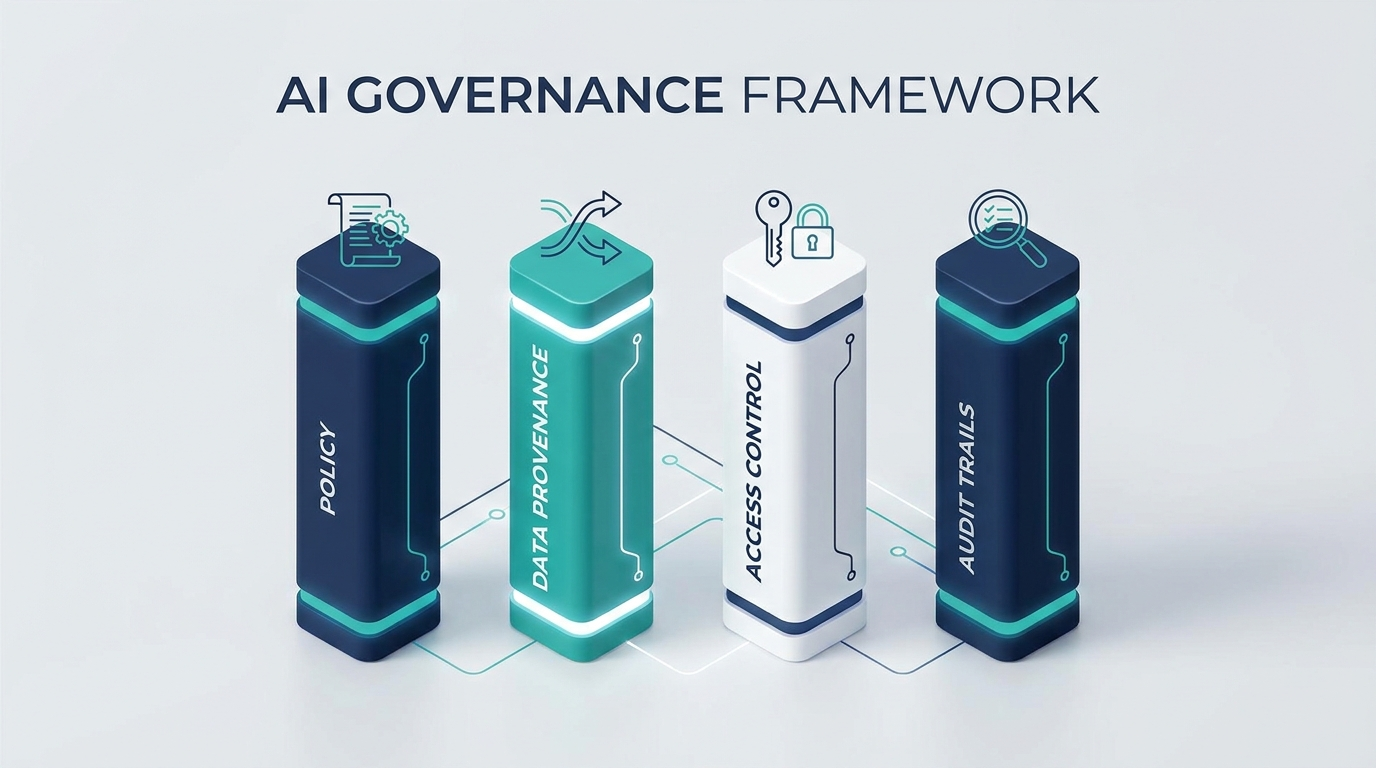
Whatever standard you map to, a durable AI governance framework rests on four load-bearing components. Each one has to be enforced in code, not just described in policy.
Policy and Accountability
Every model, data source, and use case needs a named owner and a written policy for acceptable use. Accountability is the layer auditors start with, because it establishes who answers for a given decision. Keep policies versioned and tied to the systems they govern, so a change in one is reflected in the other.
Data Provenance and Lineage
Provenance is the record of where each piece of information came from and how it moved through your systems. For AI, that means tracing every answer back to its source documents. Sovrinty enforces verbatim answers and captures a Golden Spike, an immutable per-answer audit trail, so a claim can always be tied to the exact source that produced it. Provenance is what turns an AI output into an answer your business can prove.
Access Control at the AI Layer
Traditional access control stops at the database. AI needs attribute-based access control (ABAC) enforced at the model layer, so a user only ever gets answers drawn from data they are cleared to see. Enforcing ABAC and a zero-exfiltration posture at the AI layer closes the gap where a model would otherwise surface restricted content to the wrong person.
Audit Trails and Monitoring
A framework is only as strong as the evidence it produces. Immutable audit trails log every request, the policy applied, the data accessed, and the answer returned. This is the difference between telling a regulator you have controls and showing them the record. Continuous monitoring then catches drift before it becomes a violation.
Mapping Your Framework to NIST, ISO, and the EU AI Act
Regulators and auditors rarely accept a bespoke framework on its own terms. They want to see it mapped to a recognized standard. The three that matter most for regulated AI are the NIST AI Risk Management Framework, ISO/IEC 42001, and the EU AI Act. The table below shows how the core components line up.
| FRAMEWORK COMPONENT | NIST AI RMF | ISO/IEC 42001 | EU AI ACT |
|---|---|---|---|
| Policy and accountability | Govern function | Leadership and AI policy clauses | Risk management system (Article 9) |
| Data provenance | Map and measure functions | Data and data governance controls | Data governance (Article 10) |
| Access control | Manage function | Operational controls | Access and security safeguards |
| Audit trails | Measure and manage functions | Performance evaluation and logging | Record-keeping and logging (Article 12) |

Note the EU AI Act stakes: penalties reach up to EUR 35 million or 7 percent of global annual turnover for the most serious violations. Mapping your controls to these standards early is far cheaper than retrofitting them after an audit finding.
From Framework to Enforcement
The gap between a governance framework that passes review and one that survives an audit is enforcement. A framework you can prove is one where every control is applied automatically at the moment AI touches your data, and every answer carries its own evidence. That is the shift from governance on paper to governance in the system. Sovrinty was built for this: a governed, model-agnostic knowledge layer for regulated industries that enforces provenance, ABAC, and immutable audit trails at the AI layer, so the answers your teams rely on are answers your business can prove. Bring your own model; the governance stays constant.
If your AI governance framework still lives in a document, see what enforcement looks like in practice. Book a Sovrinty demo and walk through how provenance, access control, and audit trails come together on a single governed layer.
FAQ
Common questions
What is an AI governance framework?
An AI governance framework is a structured system of policies, controls, and evidence that governs how an organization builds, deploys, and monitors AI. In regulated settings it must enforce those policies at the AI layer and produce an audit trail proving each output was compliant.
What are the core components of an AI governance framework?
The four load-bearing components are policy and accountability, data provenance, access control at the AI layer, and immutable audit trails. Each should be enforced in code rather than described in a document.
How does an AI governance framework map to the EU AI Act?
Its components align with the EU AI Act requirements for risk management, data governance, and record-keeping. Non-compliance can carry penalties of up to EUR 35 million or 7 percent of global annual turnover.
Is NIST or ISO 42001 better for AI governance?
They serve different purposes. The NIST AI Risk Management Framework is a voluntary, function-based guide, while ISO/IEC 42001 is a certifiable management-system standard. Many regulated organizations map to both.
Why do most AI governance frameworks fail?
Most fail because they exist only as policy documents with nothing enforcing them. When controls are not applied automatically at the point AI touches data, the framework drifts out of sync with the systems it is meant to govern.
How is AI data governance different from traditional data governance?
AI data governance extends traditional data governance to cover how models access, use, and generate data. It adds provenance for AI answers and access control enforced at the model layer, not only at the database.


