
AI governance tools are software platforms that let regulated enterprises control, monitor, and prove how their AI systems use data and produce answers. They enforce access policies, track data provenance, retain audit trails, and document model behavior, so organizations can demonstrate compliance with regulations like the EU AI Act to auditors and regulators.
| TOOL CATEGORY | WHAT IT GOVERNS | BEST FOR | GAP FOR REGULATED AI |
|---|---|---|---|
| Model monitoring and MLOps | Model performance, drift, and bias | Data science teams | Weak on answer-level provenance and access control |
| Policy and risk registers | Documentation and risk mapping | Compliance officers | Policies live on paper, not enforced in the system |
| Data governance catalogs | Data lineage and classification | Data platform teams | Stop at the data layer, not the AI answer |
| AI governance platforms | End-to-end model and use-case oversight | Enterprise AI programs | Range from reporting-only to true enforcement |
| Governed AI knowledge layer | Access, provenance, and currency of every answer | Regulated question answering and RFP workflows | Newer category; evaluate provenance depth |
Why AI governance tools matter now
Regulated organizations are deploying AI faster than they can prove it behaves. Gartner forecasts that 60 percent of enterprise AI projects will be abandoned through 2026 for lack of AI-ready data, and the gap between pilot and production is almost always governance. When a model gives an answer that ends up in a customer contract, a clinical note, or a defense proposal, someone has to show where that answer came from and who was allowed to see the underlying data.
The regulatory pressure is now concrete. Under the EU AI Act, penalties for the most serious violations reach up to EUR 35 million or 7 percent of global annual turnover, and high-risk systems carry documentation, logging, and human-oversight obligations. Frameworks like the NIST AI Risk Management Framework translate those obligations into practices that AI governance tools are meant to operationalize rather than describe on a slide.
Types of AI governance tools
The phrase covers several distinct software categories that solve different parts of the problem. Understanding the categories keeps you from buying a model monitoring tool when your real exposure is at the answer and access layer.
Model monitoring and MLOps
These tools watch models in production for drift, bias, and performance decay. They are essential for data science teams running predictive models, but they govern the model, not the specific answer a business user receives, and they rarely enforce who can access which source data.
Policy, risk, and compliance registers
Registers document AI use cases, map them to risk tiers, and store approvals. They are useful for compliance officers preparing for an audit, but their control is only as strong as the manual process behind them. When the policy lives in a spreadsheet and the AI system cannot read it, governance stays on paper.
Data governance and lineage catalogs
Catalogs classify data, track lineage, and manage quality across the warehouse. They are a strong foundation, yet they generally stop at the data layer. They can tell you where a table came from, but not whether the sentence an AI assistant just served was grounded in an approved, current source.
AI governance platforms
An AI governance platform aims to cover models and use cases end to end, from intake to monitoring to reporting. This category is growing quickly, and the products vary widely. The key question is whether the platform enforces policy inside the AI workflow or mainly reports on it after the fact.
Governed AI knowledge layers
A newer category sits between your approved knowledge and the AI answer. Instead of governing the model, it governs the response: it grounds every answer in approved sources, applies access control at the AI layer, and attaches citations so the answer is traceable. For regulated question answering, proposals, and RFP responses, this is where provability actually lives.
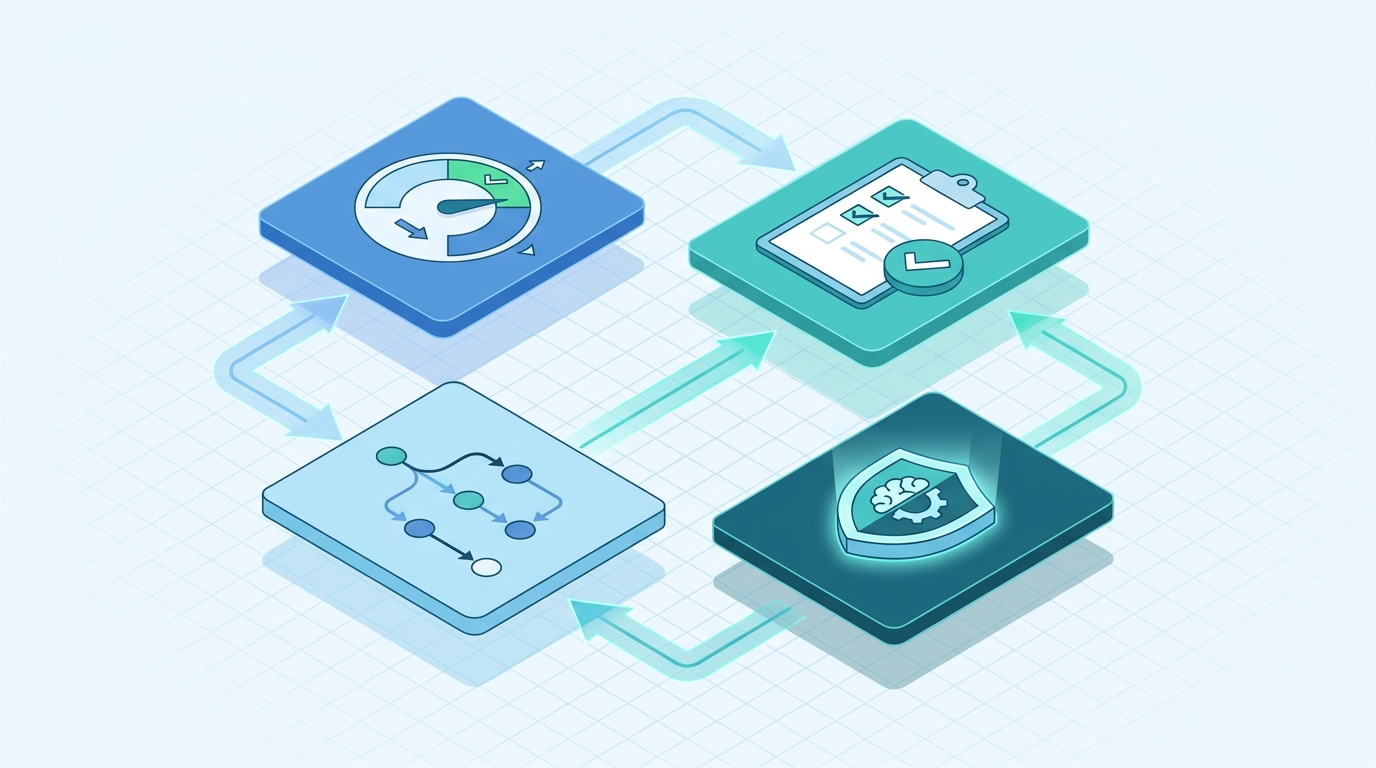
What to look for in AI governance tools for regulated industries
Enforcement over reporting. The most important distinction is whether a tool enforces governance in the architecture or simply records that a policy exists. Governance a user can bypass is documentation, not control. Prioritize tools where the rule is applied at the moment the answer is generated.
Provenance and citations. In a regulated setting, an answer without a source is a liability. Look for tools that attach a traceable citation to answers and let a reviewer follow it back to the approved document it came from.
Access control at the AI layer. Sovereignty, zero-exfiltration, and attribute-based access control are table stakes. The AI layer should respect the same permissions as the source systems, so a user never receives an answer built from data they are not cleared to see.
Currency of knowledge. Stale answers can be as dangerous as wrong ones. Favor tools that treat knowledge as something with a shelf life, so content that expires is pulled from circulation automatically rather than quietly resurfacing after a policy has changed.
Model-agnostic deployment. Regulations and models both change. A bring-your-own-model approach lets you swap or add models without re-architecting your governance, which protects the investment as the market shifts.

How Sovrinty approaches AI governance
Sovrinty is a governed AI knowledge layer built for regulated industries, where the answer has to be defensible, not just fluent. Rather than bolting policy on after generation, Sovrinty grounds answers in approved sources, applies attribute-based access control at the AI layer, and attaches citations so responses are traceable back to their origin. Knowledge that expires is pulled from circulation automatically, so teams are not quietly served stale guidance. Because the platform is model-agnostic, you can bring your own model and keep the same governance as the landscape evolves. You can see how this works on the Sovrinty product page and review the controls on the security page.
If your teams in defense, financial services, or healthcare are moving AI from pilot to production, the question auditors will ask is not whether the answer sounded right, but whether you can prove it. See how Sovrinty makes that provable with a personalized demo.
FAQ
Common questions
What are the best AI governance tools?
The best AI governance tool depends on where your risk sits. Data science teams often need model monitoring, compliance teams need policy registers, and regulated question-answering workflows need a governed knowledge layer that grounds and cites every answer. Match the tool to the layer where you have to prove behavior.
Are there free or open-source AI governance tools?
Yes, open-source options exist for model monitoring, bias testing, and documentation. They can be a solid starting point, but free tools rarely provide the access control, provenance, and audit trails that regulated industries need to satisfy auditors, so most enterprises combine them with a governed platform.
What is the difference between an AI governance tool and an AI governance platform?
A tool typically solves one part of the problem, such as monitoring or documentation, while a platform aims to cover models and use cases end to end. The more important distinction is enforcement versus reporting: whether governance is applied inside the AI workflow or only recorded after the fact.
Do AI governance tools help with EU AI Act compliance?
They can, if they operationalize the obligations rather than just describe them. The EU AI Act requires logging, documentation, and human oversight for high-risk systems, so tools that produce audit trails, provenance, and access control directly support your compliance evidence.
What should regulated industries look for in AI governance tools?
Prioritize enforcement over reporting, traceable citations on answers, attribute-based access control at the AI layer, automatic expiry of stale knowledge, and model-agnostic deployment. These are what let a defense, financial services, or healthcare team prove an AI answer is defensible.


