
AI guardrails are the controls that keep an AI system's inputs and outputs within safe, approved boundaries. They block harmful, off-policy, or ungrounded responses before a user sees them. In regulated settings, effective guardrails do more than filter: they govern which sources an answer may draw from and prove it afterward.
| APPROACH | HOW IT WORKS | STRENGTH | GAP FOR REGULATED TEAMS |
|---|---|---|---|
| Output filtering guardrails | Screens model responses after generation for toxicity, PII, or policy breaches | Fast to add, model-agnostic, blocks obvious harms | Cannot prove an answer came from an approved, current source |
| Input and prompt guardrails | Validates or constrains user prompts before they reach the model | Reduces prompt injection and misuse | Says nothing about whether the output is grounded in fact |
| Retrieval grounding | Feeds the model approved context so answers cite real documents | Improves accuracy and traceability | Grounding alone does not enforce access rules or freshness |
| Governance by architecture | Draws answers only from approved, access-controlled, current sources and records the evidence | Answers your business can prove, audit-ready by design | Requires a governed knowledge layer, not a bolt-on filter |
What AI guardrails actually control
Most teams meet AI guardrails as a bolt-on safety layer. In practice the category spans three jobs. Input guardrails validate or constrain a prompt before it reaches the model, catching prompt injection and misuse. Output guardrails screen the response for toxicity, leaked personal data, or policy violations. Behavioral guardrails keep an autonomous agent inside an approved set of actions and tools. Each is useful, and most vendors focus here because these controls are quick to add and work across any model.
The problem is what these layers assume. A filter can tell you a sentence looks unsafe. It cannot tell you whether the underlying claim is true, whether the source was approved, or whether that source is still current. For a marketing chatbot, that gap is tolerable. For an answer that feeds a loan decision, a clinical workflow, or a defense proposal, it is the whole game.
Why output filters are not enough in regulated industries
Reactive filtering treats accuracy as a probability rather than a property. Gartner forecasts that 60% of enterprise AI projects will be abandoned through 2026 for lack of AI-ready data, and ungoverned answers are a direct symptom. Regulators are moving in the same direction. Under the EU AI Act, high-risk AI systems must maintain logging, human oversight, and traceable records, with penalties reaching EUR 35 million or 7% of global turnover. The NIST AI Risk Management Framework frames the same expectation as measurable, documented trustworthiness. None of that is satisfied by a filter that quietly drops a risky sentence and leaves no evidence behind.
The cost of a guardrail that only filters
When a guardrail is purely a screen, three failures follow. Confident but wrong answers still pass whenever they read as safe. There is no record proving which source an answer came from, so an auditor cannot reconstruct the decision. And nothing stops the model from citing a document that was withdrawn or superseded months ago. The result is an AI system that feels controlled but cannot be defended when someone asks the only question that matters: how do you know this answer is right?
From filtering to governance by architecture
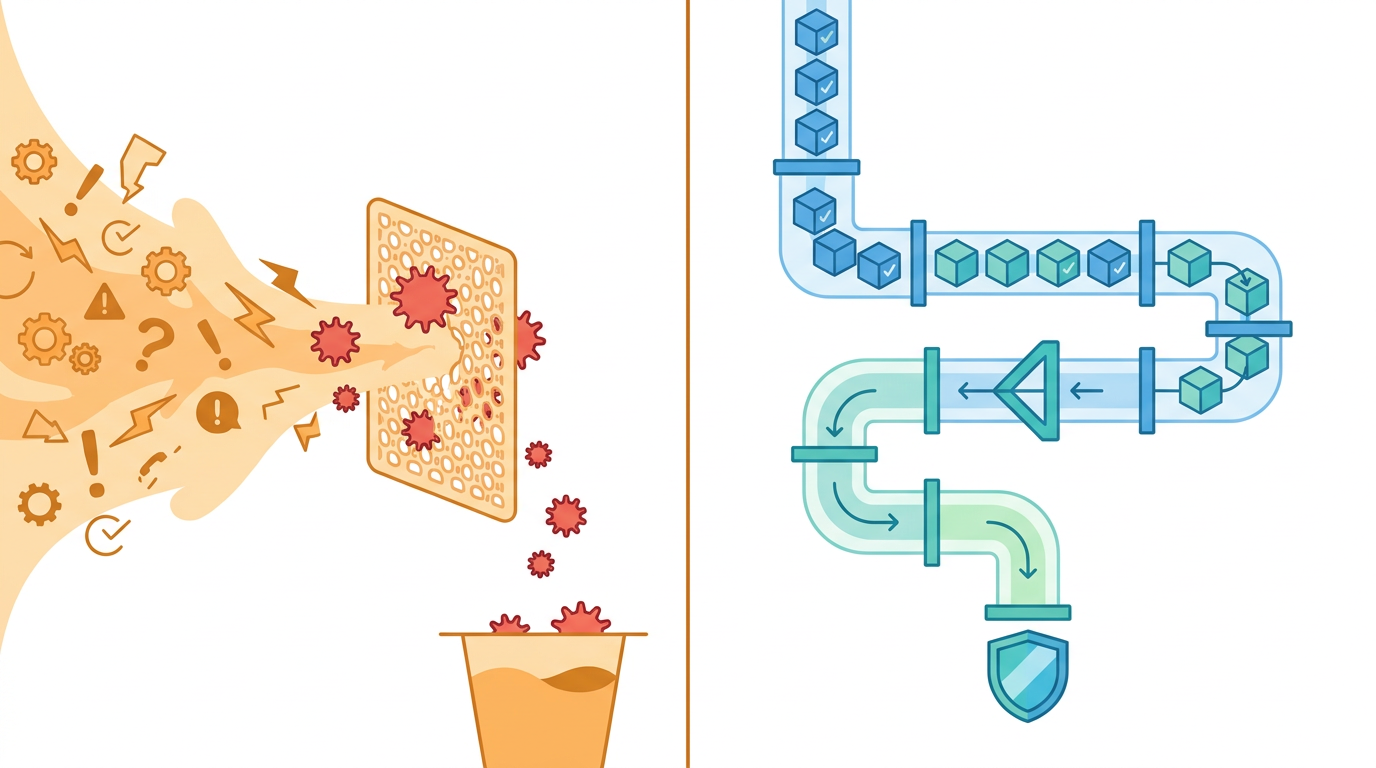
The stronger model inverts the order. Instead of generating freely and filtering afterward, a governed system decides upfront which knowledge an answer is allowed to use. Sovrinty applies this at the knowledge layer: answers are drawn only from approved, access-controlled sources, and every answer carries the provenance and citations needed to trace it back to its origin. Access is enforced with attribute-based controls at the AI layer, and content stays inside your boundary, so sovereignty and zero-exfiltration are handled by design rather than bolted on. Security here is table stakes, not the headline; the headline is that answers become provable.
Grounding, access control, and freshness as first-class controls
Three controls do the heavy lifting. Grounding means a response is assembled from retrieved, approved documents rather than the model's memory, so citations point to real records. Access control means the same question can return different answers depending on what the user is cleared to see, enforced before generation rather than filtered after. Freshness means approved knowledge expires and is pulled from circulation automatically, so a superseded policy stops feeding answers the moment it is retired. Together they turn guardrails from a safety net into a control surface.

How to evaluate AI guardrails for a regulated deployment
When you assess AI guardrails, look past the demo of a blocked slur. Ask whether every answer ships with a citation to an approved source. Ask whether access rules are applied before the model responds, not after. Ask whether retired content is removed from the answer pool automatically, and whether the system produces an audit-ready record you could hand to a regulator without extra work. If a tool cannot show provenance, honest confidence tied to the evidence, and a defensible trail, it is a filter wearing the word guardrail. Regulated teams in financial services, healthcare, and defense need the version that can prove its work.
AI guardrails will keep mattering, but the bar is rising from blocking bad outputs to proving good ones. If your team needs answers it can defend in an audit, not just responses that pass a filter, see how Sovrinty governs AI at the knowledge layer.
FAQ
Common questions
What are AI guardrails?
AI guardrails are controls that keep an AI system's inputs, outputs, and actions within approved boundaries. They block unsafe or off-policy responses, and in regulated settings they also govern which sources an answer can use and record the evidence behind it.
Do AI guardrails stop AI hallucinations?
Output filters reduce visible errors but cannot guarantee an answer is factually grounded. Reducing hallucinations reliably requires grounding responses in approved sources and citing them, so unsupported claims have nowhere to hide.
What is the difference between AI guardrails and AI governance?
Guardrails are usually reactive controls applied around a model, such as input and output filters. Governance is architectural: it decides upfront which approved, current sources an answer may draw from and proves it afterward, giving regulated teams a defensible record.
Are AI output filters enough for compliance?
No. Filters can drop a risky sentence but leave no proof of where an answer came from. Frameworks like the EU AI Act and NIST AI RMF expect logging, traceability, and human oversight, which require provenance, not just filtering.
What should AI guardrails include for regulated industries?
Grounding in approved sources, attribute-based access control applied before generation, automatic removal of stale or superseded content, and an audit-ready trail linking every answer to its source and approval status.
How do you audit AI guardrails?
Check whether each answer carries a citation to an approved source, whether access rules were enforced before the response, whether retired content is excluded automatically, and whether the system can produce a complete, defensible record on demand.


