
AI knowledge management is the practice of using AI to capture, organize, and surface an organization's internal knowledge so employees find accurate answers in seconds. In regulated industries such as financial services, healthcare, defense, and life sciences, the bar is higher. An answer is only useful if you can prove where it came from, confirm that it is current, and show that the reader was allowed to see it. That gap, between a generic AI knowledge base and a governed one, is where most tools quietly fail.
What AI knowledge management means in a regulated context
Conventional AI knowledge management connects a language model to your documents and returns fluent answers, optimizing for speed and coverage. A governed approach optimizes for something regulators actually ask about: can you defend this answer? Gartner projects that 60% of enterprise AI projects will be abandoned through 2026 for lack of AI-ready, trustworthy data, and the pattern behind that number is familiar. A pilot dazzles in a demo, then stalls the moment compliance asks who approved the source, when it was last reviewed, and why one employee saw content another could not. In regulated functions like financial services, that stall is where value goes to die.
Sovrinty frames the requirement as four properties an answer must hold at once: governed, cited, current, and provable. Miss any one and the system becomes a liability in an audit rather than an asset in a workflow.
Why most AI knowledge management tools fail an audit
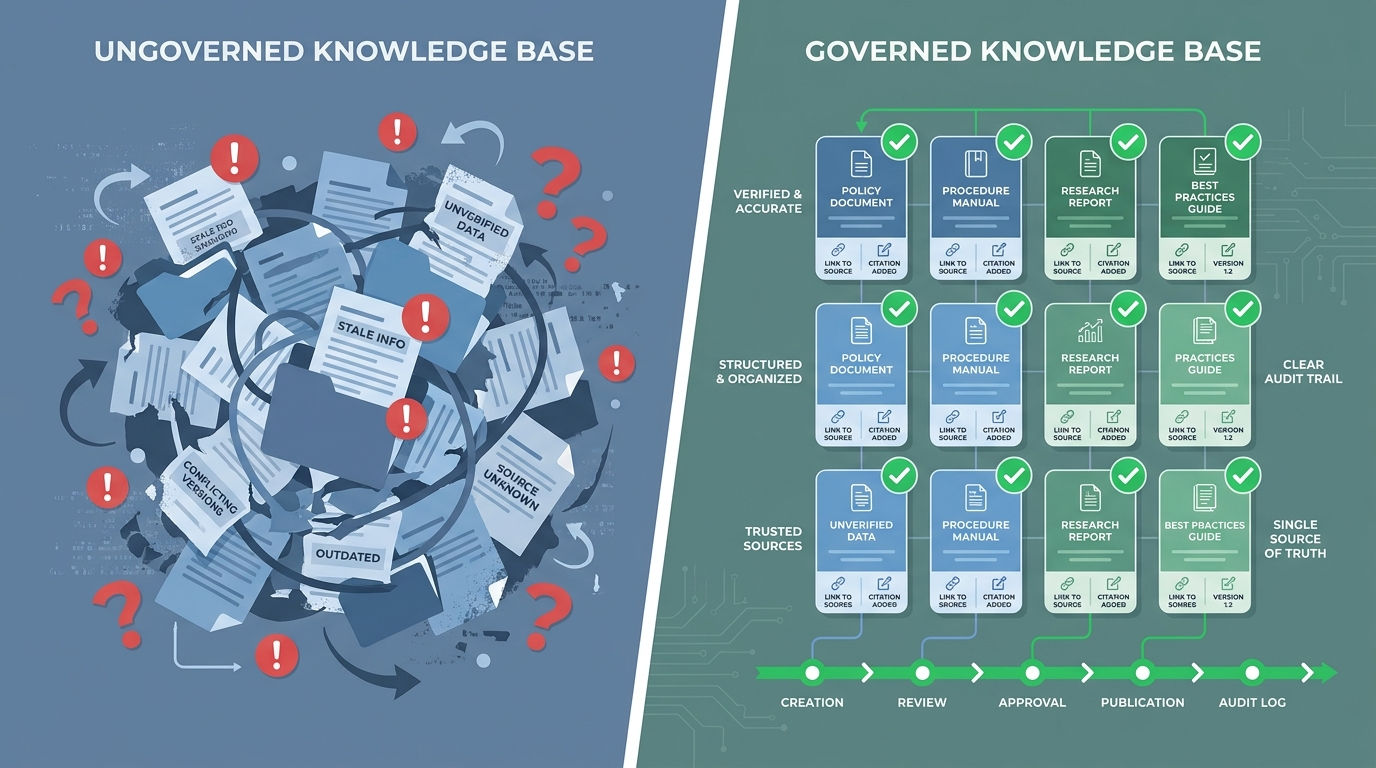
The failure is rarely the model. It is the absence of controls around the model. Three gaps show up again and again.
They cannot show their sources
Most tools generate an answer and, at best, attach a list of documents the model consulted. That is not the same as proving that every sentence is grounded in approved material. Sovrinty draws answers only from approved sources and strips unsourced sentences before an answer is served, so citation integrity is enforced at serving time rather than left to the model's discretion. The National Institute of Standards and Technology AI Risk Management Framework treats this kind of traceability as a core function of trustworthy AI, not an optional extra.
They let stale knowledge circulate
A policy that changed last quarter does not stop being wrong because it still sits in the index. Ungoverned systems keep serving outdated guidance until a human notices. Sovrinty attaches expiry to knowledge, so items carry a time-to-live and a scheduled job pulls stale content from circulation automatically, and citations flag when their underlying source has drifted. The result is knowledge that retires itself instead of silently aging.
They ignore who is allowed to see what
In regulated environments, access is a control, not a courtesy. Attribute-based access control applied at the AI layer checks entitlement at a single, fail-loud choke point before retrieval, so an answer never assembles content a user was not cleared to see. Sovereignty and zero-exfiltration matter here, but they are table stakes rather than the headline. The deeper principle is that governance lives in the architecture, not in a settings page someone can forget to configure.
Governed AI knowledge management versus a standard knowledge base
The contrast is easiest to see feature by feature. The same question runs through both systems; only one can defend its answer.
| CAPABILITY | STANDARD AI KNOWLEDGE BASE | GOVERNED AI KNOWLEDGE MANAGEMENT |
|---|---|---|
| Source of answers | Any indexed document | Approved sources only |
| Citations | Optional, document level | Enforced per answer; unsourced text removed |
| Freshness | Manual review | Automatic expiry and stale-source flags |
| Access control | App-level permissions | ABAC enforced at the AI layer |
| Confidence | Model self-report | Scored from underlying evidence |
| Audit readiness | Reconstructed after the fact | Versioned, hashed, traceable history |
Choosing AI knowledge management software you can prove
When you evaluate AI knowledge management software for a regulated function, the demo is the easy part. Pressure-test the questions an auditor will ask, and ask the vendor to show a wrong answer being caught, not just a right answer being produced. Sovrinty exposes honest confidence, where the score reflects the raw semantic evidence behind an answer before any ranking adjustments, so a thin answer looks thin instead of being dressed up. Strong security and access controls should be assumed, not celebrated.

For teams weighing an AI knowledge management system against building retrieval in-house, the difference is enforcement. Hybrid retrieval that fuses semantic and lexical search improves recall, but recall without governance still returns answers you cannot stand behind. The value sits in the controls wrapped around retrieval, and in a versioned, hashed history that records provenance when the answer is served rather than reconstructing it after an incident.
The stakes are concrete. Under the EU AI Act, penalties for the most serious violations reach EUR 35 million or 7% of global annual turnover, and high-risk uses in healthcare and finance carry documentation and transparency obligations that a black-box knowledge tool cannot meet.
Other knowledge bases store information; Sovrinty governs it. If your knowledge base has to answer to regulators as well as employees, governance cannot be bolted on at the end. See how Sovrinty governs, cites, and proves every answer on the Sovrinty platform, or book a demo with our team.
FAQ
Common questions
What is AI knowledge management?
AI knowledge management is the use of AI to capture, organize, and retrieve an organization's internal knowledge so people get accurate answers quickly. In regulated settings it must also prove sources, confirm currency, and respect access rights.
How is governed AI knowledge management different from a normal AI knowledge base?
A governed system enforces controls a standard knowledge base leaves optional: answers come only from approved sources, citations are enforced per answer, stale content is retired automatically, and access is checked at the AI layer rather than the app layer.
What should I look for in AI knowledge management software for a regulated industry?
Prioritize provable provenance, enforced citations, automatic expiry of stale content, attribute-based access control, and honest confidence scoring. Ask the vendor to show a wrong answer being caught, not just a right answer being produced.
Does AI knowledge management help with EU AI Act compliance?
It can support compliance by providing the traceability, documentation, and transparency the EU AI Act expects for high-risk uses, though compliance depends on your full governance program rather than any single tool.
Can AI knowledge management keep information current automatically?
Yes. Sovrinty attaches a time-to-live to knowledge and runs a scheduled job that pulls stale items from circulation, and it flags citations whose sources have drifted, so outdated guidance does not keep circulating.


