
AI model governance is the set of policies, controls, and audit mechanisms that govern how AI models are approved, deployed, monitored, and retired across an organization. It defines who can use which model on what data, records every decision, and keeps outputs traceable to approved sources so regulated teams can prove their AI is accountable.
| DIMENSION | UNGOVERNED AI MODELS | GOVERNED AI MODELS |
|---|---|---|
| Model selection | Teams pick any model, no approval trail | Approved model inventory with recorded sign-off |
| Data access | Broad, uncontrolled access to source data | Attribute-based access enforced at the AI layer |
| Output traceability | Answers cannot be traced to a source | Every answer cited to approved, current sources |
| Change control | Silent updates, no version history | Versioned models with logged changes |
| Audit readiness | Evidence reconstructed after the fact | Audit-ready records captured continuously |
What is AI model governance?
AI model governance is the discipline of controlling AI models across their full lifecycle, from the moment a model is proposed to the day it is retired. It sits above any single model or vendor and answers three questions a regulator or auditor will ask: which model produced this output, on what data was it allowed to operate, and can you prove the answer came from an approved source. Where model management focuses on the mechanics of deploying and serving models, governance focuses on accountability, the policies, roles, and evidence that make AI defensible.
For regulated organizations, this is not optional documentation. It is the control layer that decides whether an AI system can be trusted with a credit decision, a clinical summary, or a classified brief.
Why AI model governance matters now
The gap between AI ambition and AI accountability is widening. Gartner forecasts that 60 percent of enterprise AI projects will be abandoned through 2026 for lack of AI-ready, governed data. Models fail in production not because the math is wrong, but because no one can prove where an answer came from or whether the data behind it was still current.
Regulation has closed the window for governing after the fact. Under the EU AI Act, penalties for the most serious violations reach up to EUR 35 million or 7 percent of global annual turnover. High-risk systems now carry explicit obligations for record-keeping, transparency, and human oversight, and frameworks such as the NIST AI Risk Management Framework set the expectation that governance is continuous, not a launch-day checklist.
The core pillars of AI model governance
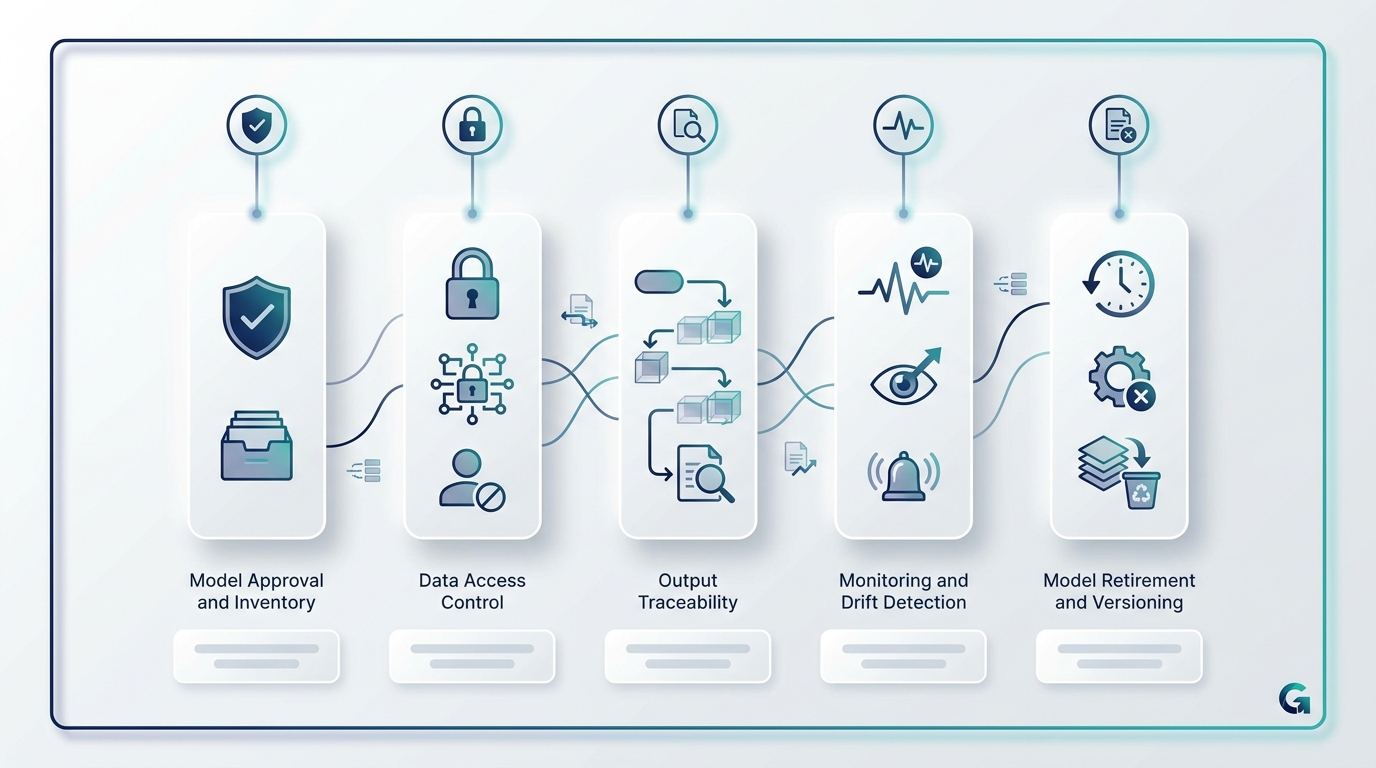
Effective AI model governance rests on five pillars. Each one turns a governance principle into an enforceable control rather than a policy document that sits unread.
Model approval and inventory
You cannot govern models you cannot see. A governed program keeps a live inventory of every model in use, who approved it, and for which use cases. Approval is recorded, not assumed, so shadow AI, meaning models adopted without review, has nowhere to hide.
Data access control at the AI layer
Governance fails when access rules live in the source systems but not in the AI that reads them. Attribute-based access control applied at the AI layer means a model only sees the data a given user is cleared to see, so a prompt cannot become a backdoor around your permissions. Sovereignty and zero-exfiltration controls sit here too, as table stakes rather than the headline.
Output traceability and provenance
Every answer an AI system serves should be traceable to the approved source it came from. Provenance, the ability to prove where an answer originated, is what separates a defensible AI system from a plausible-sounding one. Answers are grounded in cited, approved knowledge, and sentences without a source are removed before the answer is served.
Monitoring, drift, and staleness
Models and the data behind them decay. Governed knowledge expires and is pulled from circulation automatically when it passes its time-to-live or a steward supersedes it, and citations carry stale flags when the source they point to has changed. Continuous monitoring catches drift before it reaches a customer or an auditor.
Retirement and versioning
A governed model has a documented end of life. Versioning records every change, and retirement removes a model from service with a logged rationale, so you can always reconstruct which version produced a past answer.
AI model governance vs AI model management
The two terms are often used interchangeably, but they solve different problems. Model management is operational, covering how models are deployed, scaled, and served efficiently. Model governance is about accountability, proving that what those models do is authorized, sourced, and auditable. A team can have excellent model management and still fail an audit if it cannot show provenance. Governance is what a regulator inspects.
How to build governance into the architecture

The durable lesson from failed AI programs is that governance written on paper does not survive contact with production. Controls that live in a slide deck get ignored the moment they slow someone down. Governance-by-architecture means the controls are enforced by the system itself: access is checked at query time, sources are attached to answers automatically, and expired knowledge is withheld without anyone remembering to intervene.
This is especially decisive in regulated sectors. A model-agnostic approach, where governance wraps whichever model you bring rather than being tied to one vendor, lets defense, financial services, and healthcare teams adopt new models without rebuilding their controls each time.
Sovrinty gives regulated teams a governed knowledge layer that keeps AI answers cited, current, and defensible, whichever model you deploy. See how governance-by-architecture works in practice and book a walkthrough with our team.
FAQ
Common questions
What is AI model governance?
AI model governance is the set of policies, controls, and audit mechanisms that determine how AI models are approved, deployed, monitored, and retired, and that keep every output traceable to an approved source.
What is the difference between AI model governance and AI model management?
Model management is operational, covering how models are deployed and served, while model governance is about accountability: proving models are authorized, their outputs are sourced, and their decisions are auditable.
Why is AI model governance important for regulated industries?
Because regulators require proof, not assurances. Frameworks like the EU AI Act and the NIST AI Risk Management Framework demand record-keeping, transparency, and human oversight, and penalties reach up to EUR 35 million or 7 percent of global turnover.
What are the core pillars of AI model governance?
The five pillars are model approval and inventory, data access control at the AI layer, output traceability and provenance, monitoring for drift and staleness, and model retirement and versioning.
How does AI model governance reduce hallucinations?
By grounding answers in approved, cited sources and removing sentences that lack a source before the answer is served, so outputs reflect governed knowledge rather than unverified generation.
Does AI model governance work across different AI models?
Yes. A model-agnostic, governance-by-architecture approach applies the same controls to whichever model you deploy, so you can adopt new models without rebuilding your governance.


