
Attribute based access control (ABAC) is an authorization model that grants or denies access by evaluating attributes of the user, the data, the action, and the environment against a written policy, rather than by assigning fixed roles. For AI systems, ABAC decides what a model is permitted to retrieve before it generates an answer.
That last sentence is where most enterprise AI programs fail. Access control designed for humans opening files does not survive contact with a model that can retrieve, summarize, and recombine thousands of documents in a single query.
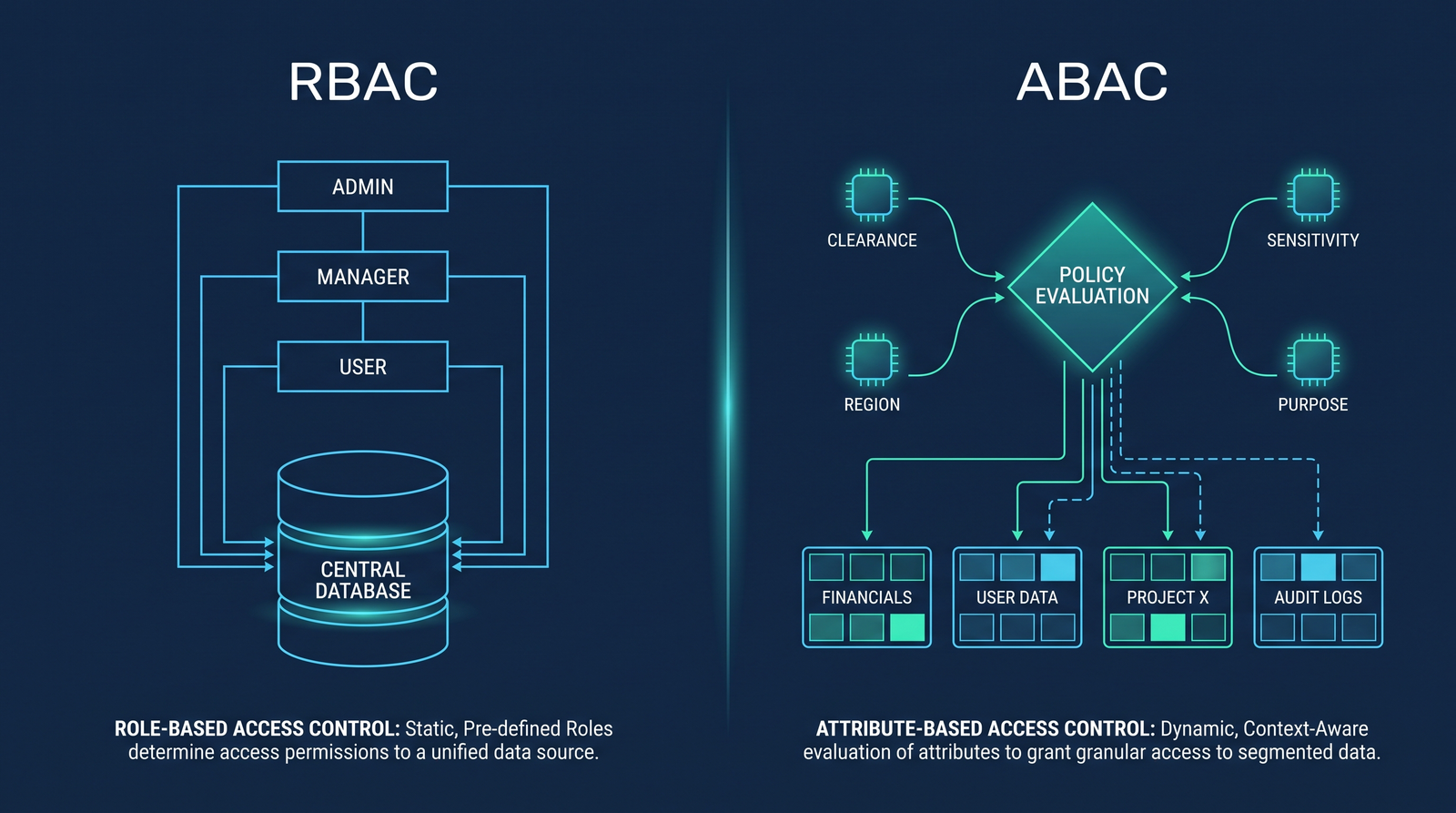
| DIMENSION | ROLE BASED ACCESS CONTROL (RBAC) | ATTRIBUTE BASED ACCESS CONTROL (ABAC) |
|---|---|---|
| Decision input | Static role assigned to the user | Attributes of user, data, action, and environment |
| Granularity | Coarse, at the system or folder level | Fine, down to the individual document or field |
| Policy change | Requires new roles and re-provisioning | Change the policy, no role sprawl |
| Context awareness | None, a role is a role | Evaluates clearance, region, purpose, and device |
| Fit for AI retrieval | Poor, roles cannot filter passages at query time | Strong, narrows the candidate set before generation |
| Audit output | Who held which role | Which attributes justified this specific answer |
What Attribute Based Access Control Actually Evaluates
ABAC replaces the question "what role does this person hold" with "do the attributes of this request satisfy the policy". The US National Institute of Standards and Technology formalized the model in SP 800-162, which defines ABAC as a method where access is granted based on assigned attributes and a set of policies expressed in terms of those attributes. Four categories matter.
Subject attributes
Facts about the requester: clearance level, department, employment status, geography, certification, project assignment. These are read from the identity provider at request time, not copied into a static access list that drifts out of date the moment someone changes teams.
Resource attributes
Facts about the data: classification, owning business unit, export control status, contract number, jurisdiction of origin, approval state, expiry. In a governed knowledge layer these tags are first class metadata on every artifact, not a folder name someone hopes is accurate.
Action attributes
What is being attempted: read, summarize, quote verbatim, export, or feed into a downstream model. AI makes this category newly important. Permission to read a clinical protocol is not permission to paste it into an external model context window.
Environment attributes
The conditions around the request: device posture, network location, time of day, and whether the session runs inside an accredited enclave. These conditions are what let ABAC deliver the continuous, per-request verification described in NIST's zero trust architecture guidance.
Why Roles Break at the AI Layer
Role based access control assumes a stable mapping between a job title and a set of resources. It worked when access meant opening a folder. Two things break that assumption once a language model sits in front of the corpus.
First, retrieval does not respect folders. A retrieval augmented generation pipeline embeds the corpus and returns the closest matches to a query. Unless the filter runs at retrieval time, the model will surface a passage from a restricted contract simply because it was semantically similar to the question. The role was correct at the application boundary and irrelevant at the vector boundary.
Second, roles cannot express conditions. "Analysts may read financial models" is a role. "Analysts may read financial models for accounts in their own region, excluding pre-announcement material, and may not reproduce figures verbatim in client-facing output" is a policy. Encoding that second sentence as roles produces role explosion: hundreds of near-duplicate roles nobody can audit and nobody deprovisions.
The cost of getting this wrong is not theoretical. Gartner forecasts that 60% of enterprise AI projects will be abandoned through 2026 because organizations lack AI-ready data. A large share of that is governance debt: teams cannot safely point a model at the corpus, so the pilot stalls in security review and quietly dies.
Attribute Based Access Control for AI Needs Two Enforcement Points
Filter before generation, not after
Output filtering is the common shortcut: let the model retrieve everything, then scan the response for anything sensitive. It fails in both directions. It leaks, because a paraphrase of a restricted figure is still a disclosure and a classifier will miss it. It also over-blocks, because the filter has no idea why a passage was retrieved. ABAC applied at retrieval narrows the candidate set to what the requester is entitled to see, so the restricted content never enters the context window at all. That is the difference between a guardrail and a gate.
Enforce at the answer, not the interface
The second enforcement point is the answer itself. Attribute policy should govern not only what was retrieved but what may be said and how. An answer assembled only from approved sources, with unsourced sentences removed before it is served, is a different artifact from a fluent summary of whatever the index happened to return. Sovereign deployment matters here too: neither the attributes nor the content should have to leave the customer boundary in order to be evaluated. Sovrinty applies ABAC at the AI layer rather than bolting it onto the application, which we cover in our security architecture.
How to Implement ABAC at the AI Layer
1. Inventory and tag the corpus. ABAC is only as good as its resource attributes. Classification, jurisdiction, owner, approval state, and expiry belong on every artifact before a model touches it. Untagged content should default to denied, never to open.
2. Source subject attributes live. Read clearance, department, and geography from the identity provider at request time. Cached entitlement lists are wrong within days and nobody notices until an audit.
3. Write policies as code, not prose. A policy in a PDF is a wish. A policy in a machine-evaluated rule set is a control. This is the single largest gap between organizations that pass an AI audit and organizations that fail one.
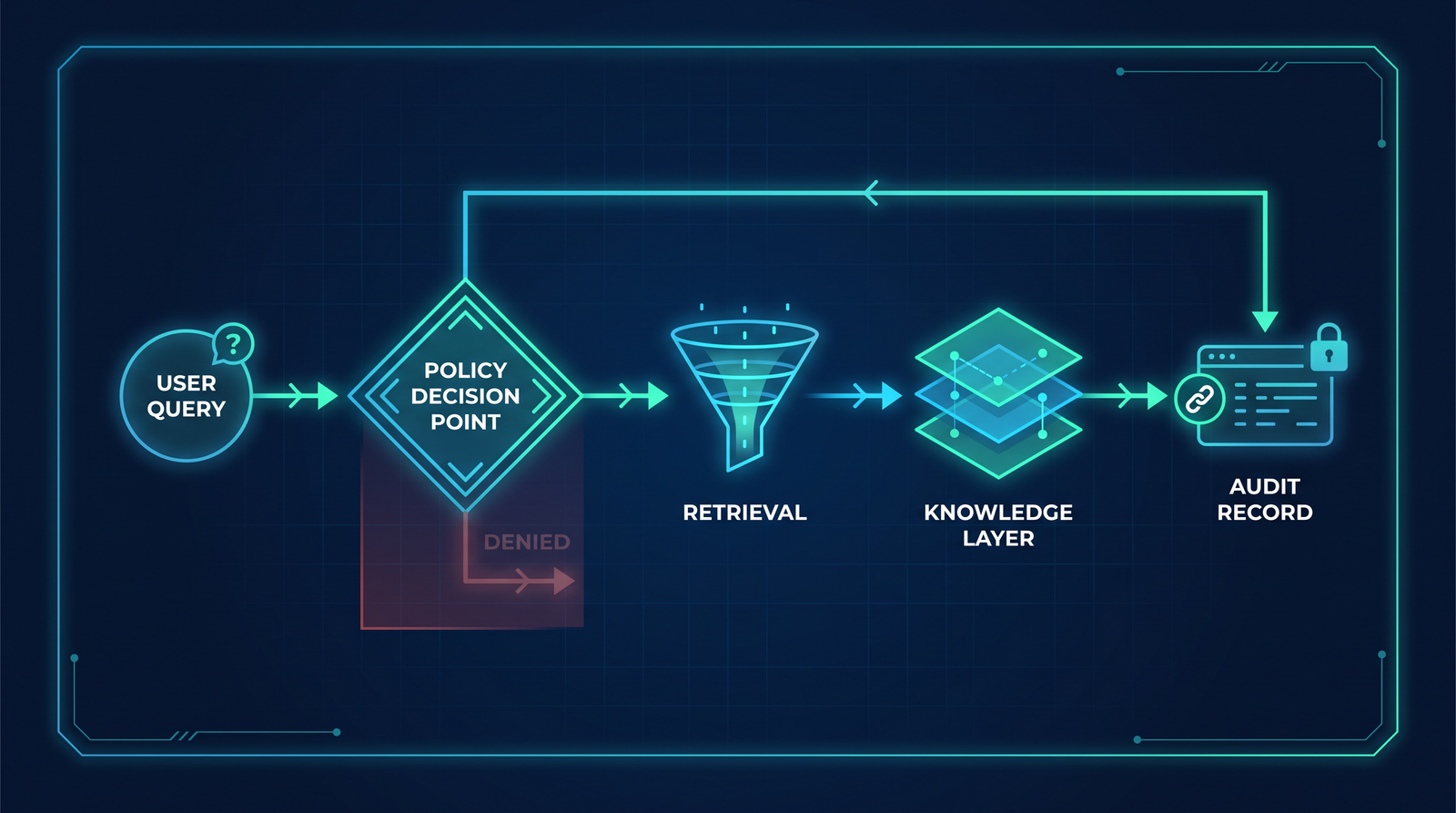
4. Enforce at retrieval. The policy decision point must sit between the query and the index, filtering candidates before ranking rather than censoring output afterward. The two are not equivalent and auditors increasingly know the difference.
5. Constrain the action, not just the read. Separate permissions for view, quote, summarize, and export. Export is where most real data loss happens, and it is the permission most often left implicit.
6. Log the decision, not just the event. Record which attributes were evaluated, which policy version applied, and which sources were admitted, for every answer the system produces.
Enforcement Without Evidence Is Not Compliance
An access decision that leaves no record is indistinguishable, twelve months later, from no access decision at all. Regulators increasingly ask for the second artifact. The EU AI Act requires providers and deployers of high-risk systems to keep automatically generated logs and technical documentation sufficient to demonstrate conformity, with penalties reaching EUR 35 million or 7% of global annual turnover for the most serious violations.
This is why attribute enforcement has to be paired with knowledge that stays traceable and current. Every answer should cite the approved sources behind it, and that knowledge should expire and be pulled from circulation automatically rather than sitting in the index long after it stopped being true. Content hashes surface drift, stewards record supersession, and citations carry stale flags when the ground has moved. The output is then not an assertion that the system was governed. It is a defensible, audit-ready record of exactly what the answer rested on. In regulated work that distinction is the entire point, which is why we describe the outcome as answers your business can prove.
If your AI program is stalled because nobody can guarantee what the model is allowed to see, the fix is architectural rather than procedural. See how attribute enforcement, cited sourcing, and audit-ready records work together for regulated teams, or book a demo to walk the policy model through your own corpus.
FAQ
Common questions
What is attribute based access control (ABAC)?
ABAC is an authorization model that grants or denies access by evaluating attributes of the user, the data, the action, and the environment against a written policy. Instead of asking what role someone holds, it asks whether the attributes of this specific request satisfy the rule.
What is the difference between ABAC and RBAC?
RBAC grants access based on a static role assigned to a user, while ABAC evaluates dynamic attributes at request time. RBAC is simpler to set up but cannot express conditions such as region, purpose, or data sensitivity without creating hundreds of near-duplicate roles.
Why does AI need attribute based access control?
Because AI retrieval ignores folder boundaries. A model searching by semantic similarity can surface restricted passages that a role-based permission never anticipated. ABAC filters the candidate set before generation, so restricted content never reaches the model's context window.
Can ABAC and RBAC be used together?
Yes, and most enterprises should. Roles remain a useful coarse filter for application-level access, with ABAC layered underneath to make fine-grained decisions about individual documents, fields, and actions at the AI layer.
Does attribute based access control satisfy EU AI Act requirements?
ABAC alone does not. The Act requires automatically generated logs and documentation demonstrating conformity, so enforcement must be paired with a durable, traceable record of which sources and policies each answer rested on. Enforcement without evidence is not compliance.
Which attributes should we start with?
Start with data classification, jurisdiction, and approval state on the resource side, plus clearance and business unit on the subject side. Those five cover the majority of real denials in regulated environments and can be sourced from systems you already run.


