
RFP automation software uses AI to draft responses to RFPs, security questionnaires, and due diligence requests from a central knowledge library, cutting response time from weeks to days. In regulated industries, the differentiator is governance: whether every generated answer can be traced to an approved, current, access-controlled source.
That governance question decides more than compliance. It decides win rates. Buyers in defense, financial services, and healthcare increasingly audit how a vendor's answers were produced, and an answer you cannot trace is an answer you cannot defend in a bid protest, a regulator inquiry, or a renewal negotiation.
| CAPABILITY | UNGOVERNED RFP AUTOMATION | GOVERNED RFP AUTOMATION |
|---|---|---|
| Answer source | Any indexed document, current or not | Curated, approved knowledge only |
| Traceability | None or partial | Immutable per-answer audit trail |
| Wording control | Model paraphrases freely | Verbatim enforcement for approved language |
| Access control | Folder-level permissions | ABAC applied at the AI layer |
| Stale content | Discovered after submission | Flagged automatically via staleness cascade |
| Data exposure | Content may leave your boundary | Zero-exfiltration architecture |
What RFP Automation Software Does
Modern RFP automation platforms ingest a content library, match incoming questionnaire items to prior answers, and use large language models to draft new responses in the right tone and format. Proposal teams, presales engineers, and security questionnaire owners report cutting first-draft time by well over half, which is why the category keeps growing even as software budgets tighten.
Speed, however, is now table stakes. Nearly every vendor can generate a plausible paragraph. The open question is whether that paragraph is true, current, approved, and permitted for the audience reading it. For teams answering financial services due diligence or defense procurement questionnaires, that is a governance problem, not a generation problem.
The Trust Gap in AI RFP Software
Generic AI RFP software drafts answers from whatever content it can index: old proposals, outdated product sheets, superseded certifications. The model has no concept of which claim is still accurate or which paragraph legal actually approved. Gartner forecasts that 60 percent of enterprise AI projects will be abandoned through 2026 for lack of AI-ready data, and RFP content libraries are among the messiest data estates in any company.
The failure modes are concrete. A response cites a security certification that lapsed last quarter. A model paraphrases approved legal language just enough to change its meaning. A draft exposes pricing reserved for another customer segment because the AI could see content its reader should not. Each one is a silent liability that surfaces at the worst possible moment: after submission.

What Governed RFP Automation Looks Like
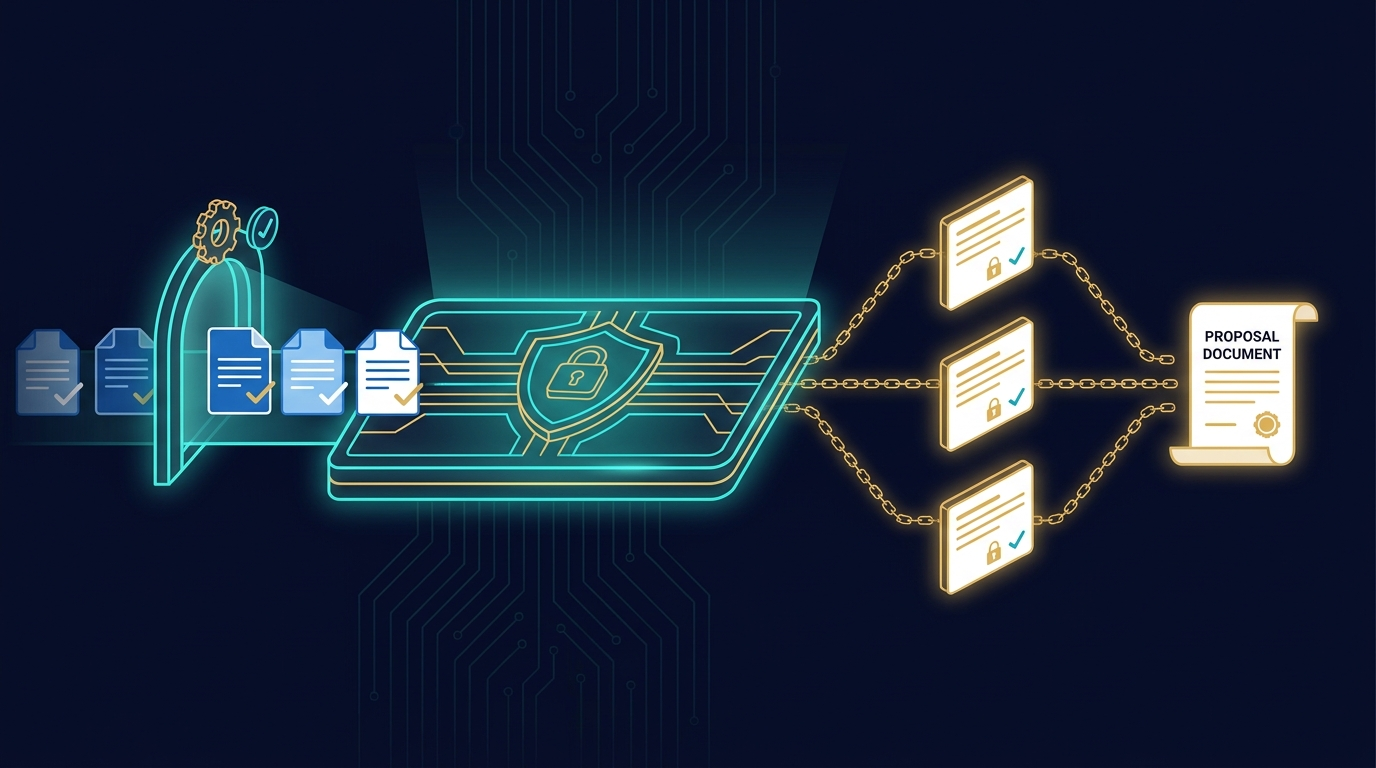
Governed RFP automation treats the knowledge behind every answer as a controlled asset. Instead of generating from an unmanaged pile of documents, the AI draws exclusively from a governed knowledge layer, and every output carries evidence.
Provenance for every answer
Each generated response should link back to the exact approved source it came from, with an immutable record of what was used, when, and under which policy. Sovrinty calls this the Golden Spike audit trail: a per-answer record that turns "trust us" into "here is the evidence."
Verbatim enforcement for regulated language
Some content must never be paraphrased: indemnification clauses, certification statements, regulated disclosures. Verbatim enforcement lets content owners mark language the AI must reproduce exactly, so legal review happens once instead of on every draft.
Access control that follows the answer
Attribute-based access control (ABAC) at the AI layer means the model can only answer with content the requesting user is entitled to see, and a zero-exfiltration architecture keeps your knowledge inside your boundary. A staleness cascade flags every downstream answer the moment a source document expires, so retired claims never resurface in next quarter's bids.
How to Evaluate RFP Automation Software
Regulated buyers should push past demo speed and ask questions that expose governance depth. Can the vendor show the source and approval status behind any generated answer? What happens to existing answers when a source document is retired? Can access policies be enforced at answer time rather than at folder level? Is the platform model-agnostic, so you can bring your own model as procurement policy or regulation changes?
The regulatory backdrop makes these questions urgent. The EU AI Act carries penalties up to EUR 35 million or 7 percent of global turnover, and frameworks like the NIST AI Risk Management Framework are turning into procurement checklists. RFP responses are exactly the kind of externally visible, high-stakes AI output that auditors and buyers will sample first.
RFP automation should make your fastest answer your most defensible one. Sovrinty's governed knowledge layer gives proposal teams speed with provenance: answers your business can prove, on the model of your choice, inside your own boundary. See it on your own content in a demo.
FAQ
Common questions
What is RFP automation software?
RFP automation software uses AI to draft responses to RFPs, RFIs, and security questionnaires from a central content library, matching questions to approved answers and generating new drafts, which cuts response time from weeks to days.
How is governed RFP automation different from generic AI RFP software?
Governed RFP automation generates only from curated, approved knowledge and attaches provenance to every answer, including an immutable audit trail, verbatim enforcement of approved language, and access control applied at answer time. Generic tools draft from any indexed content with little or no traceability.
Can RFP automation software be used in regulated industries?
Yes, if it meets governance requirements: traceable sources for every answer, enforced access controls, no data leaving your security boundary, and audit evidence a regulator or buyer can inspect. Defense, financial services, and healthcare teams should evaluate governance before generation quality.
How does AI RFP software handle hallucinations?
The reliable control is architectural: restrict generation to a governed knowledge layer of approved content, enforce verbatim reproduction of regulated language, and attach per-answer provenance so reviewers can verify any claim against its source before submission.
What should I ask vendors when evaluating RFP automation software?
Ask to see the source and approval status behind a generated answer, what happens to answers when a source document expires, whether access policies apply at answer time, whether the platform is model-agnostic, and whether your content ever leaves your security boundary.


