
Shadow AI is the use of AI tools, chatbots, and assistants inside a business without IT approval, security review, or governance. Employees paste company data into public models to work faster, creating invisible data leakage, compliance exposure, and unverifiable answers that no one can trace, audit, or defend when a regulator or customer asks questions.
| DIMENSION | SHADOW AI | GOVERNED AI |
|---|---|---|
| Data exposure | Company data leaves the perimeter into public models | Data stays inside a sovereign, zero-exfiltration boundary |
| Source of answers | Open internet plus whatever the model infers | Approved, current company knowledge only |
| Traceability | No record of what was asked or answered | Every answer cited and traceable to its source |
| Access control | Anyone can ask anything from any account | Permissions enforced at the AI layer with ABAC |
| Audit readiness | Nothing to show a regulator | Audit-ready evidence for every response |
| Stale content | Outdated material circulates indefinitely | Expired knowledge is pulled from circulation automatically |
What Is Shadow AI and Why It Keeps Growing
Shadow AI follows the same path shadow IT took a decade ago, but it moves faster and carries more of the business with it. An employee who pastes a client contract into a free chatbot gets a useful summary in seconds. The sanctioned alternative, if one exists, is often slower, less capable, or locked behind a review queue. Multiply that choice across thousands of employees and shadow AI stops being an edge case and becomes the default operating mode.
IBM describes shadow AI as one of the fastest growing gaps between security policy and employee behavior, and the pressure behind it is structural. Teams are measured on output, generative tools deliver output, and governance has not kept pace. Gartner forecasts that 60 percent of enterprise AI projects will be abandoned through 2026 for lack of AI-ready data, and every stalled official project pushes more employees toward whatever tool is one browser tab away.
Shadow AI Risks Compliance Teams Cannot Ignore
The danger of shadow AI is not that employees are malicious. It is that every unsanctioned prompt creates risk the organization cannot see, cannot measure, and cannot undo. Three categories matter most for regulated industries.
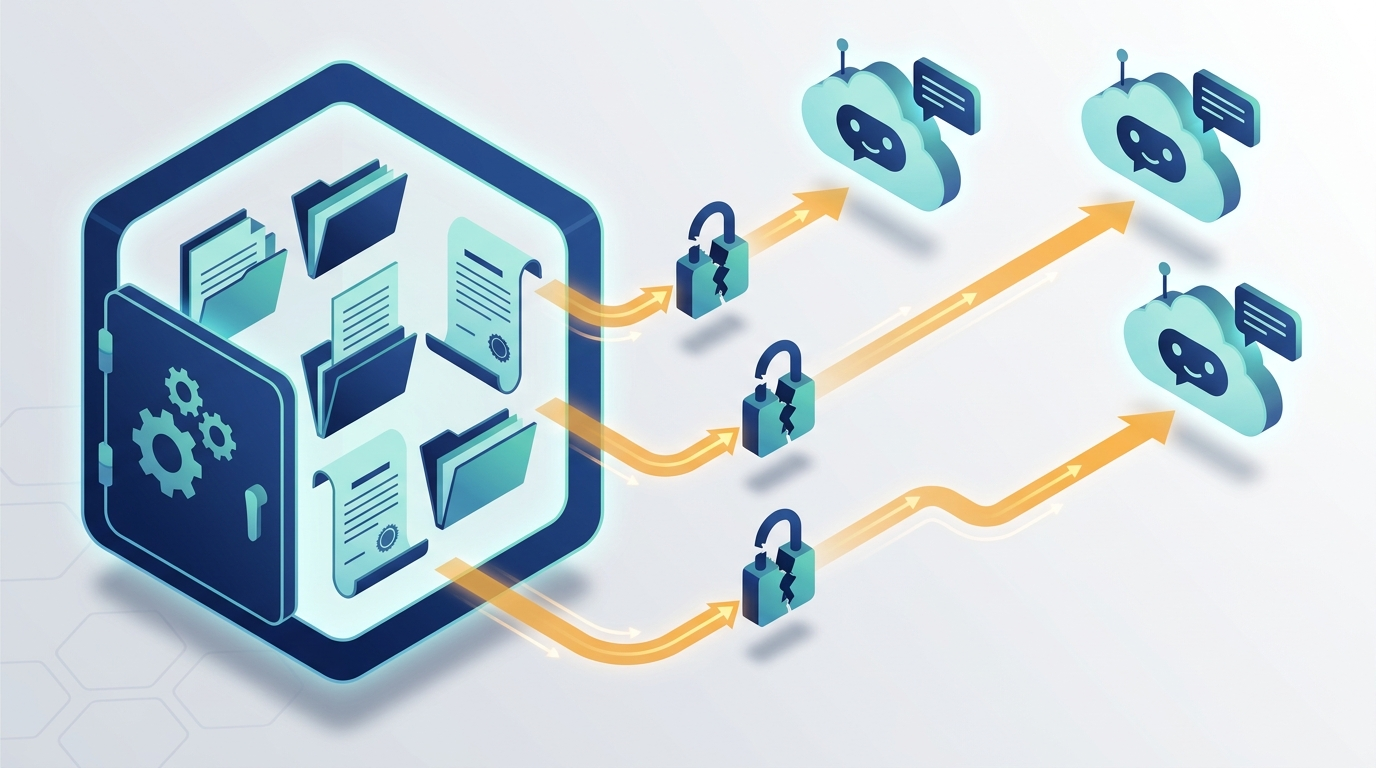
Data leakage you cannot recall
Once proprietary data enters a public model through a personal account, there is no recall mechanism. Contract terms, pricing, patient details, and deal strategy can end up outside the perimeter permanently. Unlike a misdirected email, the exposure is invisible: no log records what left, so security teams cannot even scope the damage.
Compliance exposure under the EU AI Act
The EU AI Act carries penalties of up to EUR 35 million or 7 percent of global turnover, and it does not exempt AI use the company never approved. A bank, hospital, or defense contractor is accountable for how AI touches its data and decisions whether or not the tool was sanctioned. Shadow AI turns every unmanaged prompt into a potential regulatory finding.
Answers no one can defend
Shadow AI output flows into proposals, client communications, and regulatory filings with no citation, no source, and no review trail. When a customer or auditor asks where a claim came from, there is no answer. For businesses that win work on trust, an unverifiable answer is a liability wearing the company letterhead.
Shadow AI Detection Helps, but It Treats the Symptom
Shadow AI detection usually means network monitoring, browser controls, cloud access security brokers, and even expense report audits for AI subscriptions. These tools are worth deploying, and frameworks like the NIST AI Risk Management Framework rightly emphasize mapping where AI is actually used. But detection treats the symptom. Blocking a tool does nothing about the demand that created it, and employees who found one workaround will find another. Detection tells you where the fire is; it does not remove the fuel.
The Durable Fix: Give Employees Governed AI
Bans fail because they ask employees to choose between productivity and policy. The only durable fix is a sanctioned alternative that is as fast as the shadow tool and provably safer. That is governance by architecture, not governance by memo.

A governed AI knowledge layer answers only from approved company sources, cites every answer back to the document it came from, and enforces permissions at the AI layer so people only see what they are entitled to see. Provenance is built in: every response is traceable, expired knowledge is pulled from circulation automatically, and the record is audit-ready by default. Because the layer is bring-your-own-model, the business keeps model flexibility without giving up control of its data.
For regulated sectors such as financial services, healthcare, and defense, this flips the shadow AI equation. The governed path becomes the easy path: employees get fast, cited answers from current company knowledge, and compliance gets evidence instead of blind spots. Shadow AI thrives on the gap between what employees need and what IT provides; close the gap and the shadow disappears.
If your teams are already using AI in the shadows, the fastest way to regain control is to give them something better. Book a Sovrinty demo to see what governed, cited, audit-ready AI answers look like on your own knowledge.
FAQ
Common questions
What is shadow AI?
Shadow AI is the use of AI tools inside an organization without IT approval, security review, or governance, such as employees pasting company data into public chatbots through personal accounts.
What are the biggest shadow AI risks?
The biggest shadow AI risks are unrecoverable data leakage into public models, regulatory exposure under rules like the EU AI Act, and unverifiable AI answers entering client-facing and regulatory documents.
How can companies detect shadow AI?
Companies detect shadow AI with network monitoring, cloud access security brokers, browser controls, and audits of AI subscriptions. Detection is useful but only maps the problem; it does not remove the demand driving it.
Should companies ban unauthorized AI tools?
Outright bans rarely work because they force employees to choose between productivity and policy. The more durable approach is providing a governed AI alternative that is equally fast and provably safe.
Is shadow AI the same as shadow IT?
Shadow AI is a subset of shadow IT focused on unsanctioned AI tools. It is riskier than classic shadow IT because data sent to public models cannot be recalled and AI output flows directly into business decisions.
How does governed AI eliminate shadow AI?
Governed AI eliminates shadow AI by making the sanctioned path the easiest path: fast answers drawn only from approved company sources, with citations, access control at the AI layer, and audit-ready records.


