
A single source of truth (SSOT) is one governed, authoritative record for a given fact, held in one place so that every system, person, and AI model reads the same answer. In regulated enterprises it is not simply a database. It is an approved, owned, dated, and traceable body of knowledge that AI is permitted to cite.
| APPROACH | WHAT IT HOLDS | WHO OWNS ACCURACY | HOLDS UP UNDER AUDIT |
|---|---|---|---|
| Shared drives and wikis | Documents anyone can edit or copy | No named owner | No. There is no record of review, approval, or expiry |
| Data warehouse | Structured records and metrics with lineage | Data engineering | Partly. Lineage covers metrics, not narrative knowledge |
| System of record | Transactional records for one domain | The owning application team | Yes for transactions, no for interpretation |
| Single source of truth for AI | Approved answers with source, owner, and expiry | A named subject matter expert | Yes. Every answer traces to an approved, dated source |
Why a Single Source of Truth Decides Whether AI Works
Gartner forecasts that through 2026, 60 percent of enterprise AI projects will be abandoned because the organization lacks AI-ready data. The phrase is doing quiet work there. AI-ready does not mean more data. It means data the organization can stand behind.
The failure is rarely dramatic. Point a retrieval system at a shared drive holding four versions of the same policy and the model does not stop to ask which one is current. It answers confidently from whichever version scored highest on similarity. The answer looks correct, cites a real internal document, and is wrong by eighteen months. Nobody notices until a regulator, an auditor, or a customer does.
Multiple versions of truth are a compliance exposure
Under the EU AI Act, providers and deployers of high risk systems carry data governance and record keeping obligations, with penalties reaching EUR 35 million or 7 percent of global annual turnover for the most serious breaches. The NIST AI Risk Management Framework frames the same idea in its Govern function: you cannot manage risk in a system whose inputs you cannot account for. Neither regime asks whether your AI is clever. Both ask whether you can show your work.
Single Source of Truth vs System of Record
These two terms get used interchangeably and should not be. A system of record is authoritative for transactions inside one domain: the HR platform for employment records, the general ledger for financial postings, the electronic health record for clinical events. It answers the question of what happened.
A single source of truth for AI is authoritative for interpretation. It holds the approved wording of a control, the organization's current position on a regulatory question, the version of a procedure a clinician should actually follow. It answers the question of what we say is correct. Most enterprises have solid systems of record and no single source of truth at all, which is precisely why their AI pilots stall in legal review.
What a Single Source of Truth Requires in Regulated Industries
A named owner for every fact
Ownerless knowledge decays silently. Every entry needs a named subject matter expert accountable for it, plus a record of who approved it and when. Anonymous accuracy is not accuracy. It is optimism with a timestamp missing.
Knowledge that expires instead of quietly aging
A single source of truth that never changes is just an old source of truth. The mechanism matters. Time-to-live rules expire entries so nothing stays approved indefinitely. Supersession is recorded when a steward replaces an entry. Stale flags surface on any citation drawn from aging content. Content hashes detect when an underlying source document has drifted from the answer built on it. The goal is knowledge that leaves circulation automatically rather than knowledge someone remembers to review. That is the provenance layer Sovrinty builds underneath every answer.
Access control enforced at the AI layer
In defense, financial services, and healthcare, the same question has different correct answers depending on who is asking and what clearance, jurisdiction, or need to know applies. Attribute based access control applied at the AI layer, not only at the document repository, means retrieval itself respects those boundaries. This is table stakes rather than a differentiator, but a single source of truth that leaks across boundaries is unusable in a regulated environment. See how Sovrinty enforces it.
How to Build a Single Source of Truth Your AI Can Cite
Start narrow. A single source of truth scoped to the entire enterprise on day one never ships.
1. Pick one high consequence domain. Choose the regulatory questions your team answers most often, or the procedures where a wrong answer is expensive.
2. Inventory where answers currently live. Expect to find the real answer in three places, two of them inside someone's inbox.
3. Assign owners before you assign technology. Every fact needs a name attached to it, and that decision is organizational rather than technical.
4. Approve the answer, not just the document. A 200 page manual is a source. The approved answer is the paragraph that actually responds to the question, with the manual cited behind it.
5. Set expiry at approval time. Decide how long each answer stays valid at the moment it is approved, not in a review cycle scheduled for later.
6. Route AI retrieval exclusively through the approved set. If the model can still reach the shared drive, you have not built a single source of truth. You have built a second one.

What Changes When AI Answers From One Approved Source
Three things change measurably. Review cycles shorten, because the reviewer is checking a citation rather than re-deriving the answer. Disagreement moves upstream, from the moment of delivery to the moment of approval, which is where it belongs. And the audit question finally becomes answerable: for any answer the system produced, you can show the source, the approver, the date, and whether it was current at the time of use. For financial services teams facing examiner requests, that last point is the whole argument.
The organizations getting durable value from AI in regulated settings are not the ones with the best models. Models are increasingly interchangeable, and being able to swap one without rebuilding your governance is itself a design goal. They are the ones who did the unglamorous work of deciding what is true, writing it down once, and giving it an owner.
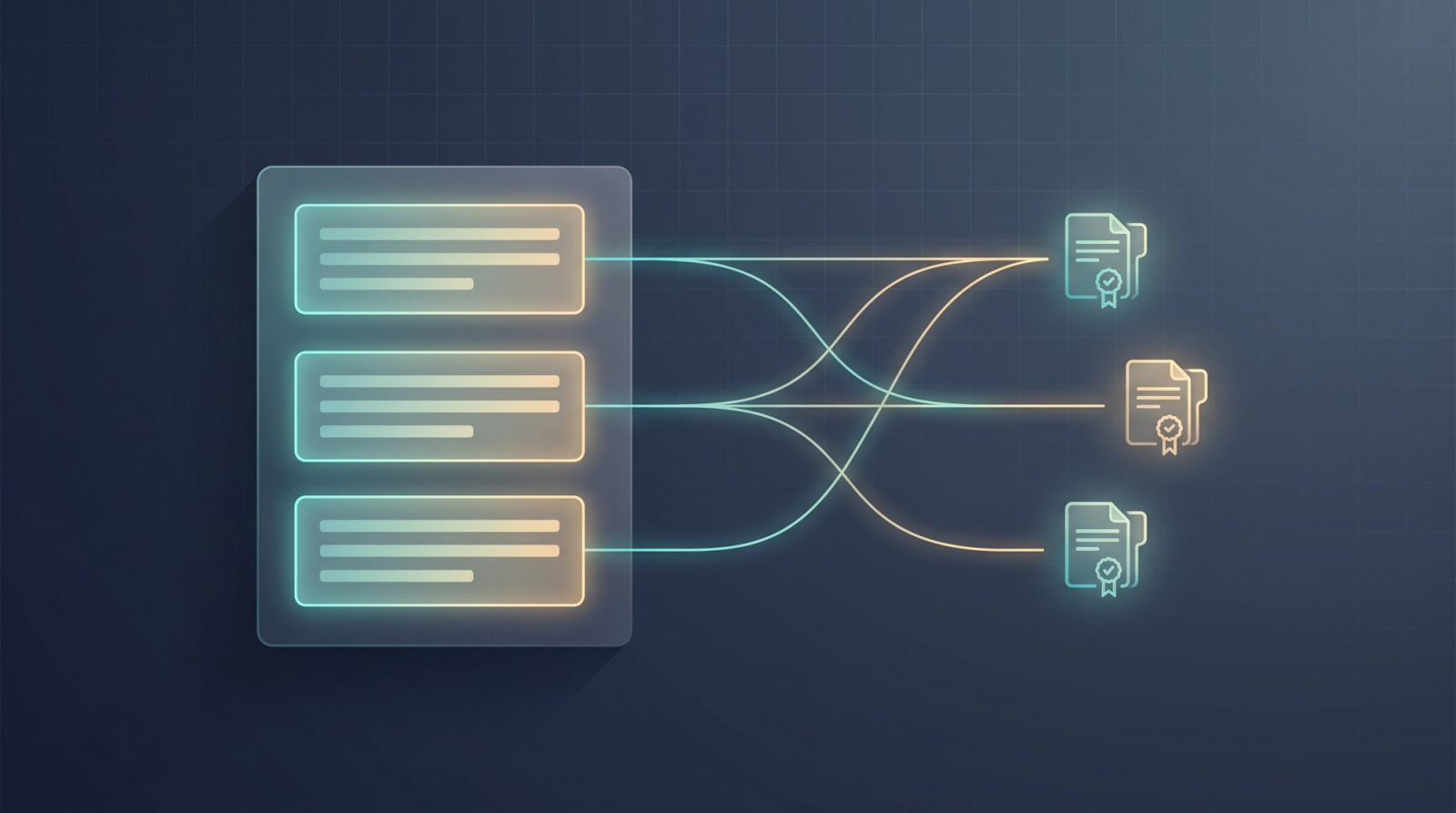
If your AI is answering from documents nobody has approved, you are shipping guesses with citations attached. Sovrinty gives regulated teams a governed single source of truth their AI can cite, with the owner, source, and currency of every answer on the record. Request a demo to see it against your own knowledge base.
FAQ
Common questions
What is a single source of truth?
A single source of truth is one governed, authoritative record for a given fact, held in one place so every system, person, and AI model reads the same answer. In regulated settings it also carries an owner, an approval date, a cited source, and an expiry.
What is the difference between a single source of truth and a system of record?
A system of record is authoritative for transactions inside one domain, such as an HR platform for employment records. A single source of truth is authoritative for interpretation: the approved answer to a question. Systems of record hold what happened. A single source of truth holds what the organization says is correct.
Why does AI need a single source of truth?
Because retrieval systems do not adjudicate between conflicting documents. Point a model at four versions of the same policy and it answers confidently from whichever one ranks highest, with a real citation attached to an outdated answer. A single approved set removes that failure mode at the source.
What are examples of a single source of truth?
Common examples include an approved control library for a compliance team, a current clinical procedure set for a health system, an approved regulatory position library for financial services, and an approved answer library for security and diligence questions. In each case the defining feature is approval and ownership, not storage location.
How do you keep a single source of truth from going stale?
Set expiry at the moment of approval rather than scheduling reviews later. Time-to-live rules pull entries from circulation automatically, recorded supersession replaces an entry when a steward updates it, stale flags appear on citations drawn from aging content, and content hashes detect when a source document has drifted from the answer built on it.
Is a data warehouse a single source of truth?
Only partly. A data warehouse consolidates structured records and usually carries lineage, which covers metrics well. It does not cover narrative knowledge: policy interpretation, approved language, and procedural guidance. Most AI answers in regulated industries draw on the narrative layer, which is where the single source of truth gap usually sits.


