
Tribal knowledge is the unwritten, experience-based know-how that lives in employees' heads rather than in documented systems. It covers the workarounds, edge cases, and judgment calls experts apply without thinking. Because it is undocumented, tribal knowledge is easily lost when people change roles or leave, and it stays invisible to the AI systems that need it.
| CAPABILITY | TRIBAL KNOWLEDGE | DOCUMENTED KNOWLEDGE | GOVERNED KNOWLEDGE |
|---|---|---|---|
| Where it lives | In experts' heads | In docs and wikis | In an approved, access-controlled layer |
| Survives staff turnover | No | Sometimes | Yes |
| Kept current | No | Manually, often stale | Expires and is refreshed on a cadence |
| Safe for AI to use | No | Not verifiable | Yes, cited and traceable |
| Access controlled | No | Rarely | Yes, by role |
What tribal knowledge is (and why it is risky)
Every organization runs on more than its documented processes. The engineer who knows which legacy system buckles under load, the claims adjuster who spots a fraudulent pattern in seconds, the compliance officer who remembers why a control was written the way it was: that is tribal knowledge. It is fast, valuable, and completely undocumented. The problem is fragility. When that person is on leave, changes roles, or retires, the knowledge leaves with them. Gartner forecasts that 60 percent of enterprise AI projects will be abandoned through 2026 for lack of AI-ready data, and undocumented expertise is a large part of what keeps data from being AI-ready. Standards bodies now treat this as a discipline in its own right: ISO 30401 defines requirements for a knowledge management system precisely because ad hoc capture does not scale.
Tribal knowledge vs institutional knowledge
The terms overlap, and some teams prefer institutional or tacit knowledge instead. Institutional knowledge is the broader pool an organization holds collectively; tribal knowledge usually refers to the unwritten slice held by a few individuals or a single team; tacit knowledge is the academic label for know-how that is hard to write down at all. Whatever you call it, the governance challenge is identical: knowledge that only lives in someone's head cannot be reviewed, secured, or safely fed to an AI system.
Why capturing tribal knowledge depends on your SMEs
You cannot document what you do not understand, which means the people who hold the knowledge, your subject matter experts, have to be involved. That is the hard part. SMEs are busy, and asking them to stop and write things down usually lands as one more task on an overloaded list. The familiar responses are 'I don't have time,' 'didn't I already explain this,' and 'I'm not sure what you need from me.' Asking for knowledge is not enough. You need a process that makes contributing fast, low-effort, and clearly worth it, or the knowledge stays locked where it is.
How to get SMEs to share tribal knowledge
The goal is to lower the cost of contributing until sharing is easier than repeating yourself. A few tactics consistently work.

Show the value, for them specifically
SMEs help when they can see the payoff. Frame it around their time: the answer they write once replaces the same explanation given twenty times. Concrete impact lands best, for example, the one-pager you helped with was viewed 300 times and cited in five support tickets last quarter. That reframes documentation as leverage, not overhead.
Make contributing effortless
Most experts are not writers, and they should not have to be. Accept knowledge in whatever form is easiest and clean it up later:
- A recorded call or screen-share instead of a written draft
- Rough notes, a diagram, or a flowchart
- A strong answer they already gave in Slack or a support ticket, turned into an article
- A short template that structures what to cover, so they only supply the substance
You own the formatting, tone, tagging, and structure. Their only job is accuracy.
Embed it in the workflow and give them control
One-off requests fade; embedded habits last. Tie updates to real triggers rather than reminders: a process changes, so the related article updates; an incident happens, so the lesson gets captured; a feature launches, so troubleshooting steps get added. Just as important, give experts control without the maintenance burden. Let them approve the final version before it goes live, set a review cadence that suits them, and name them as owners while you manage the upkeep. When SMEs trust that their name will not be attached to something stale or wrong, they contribute more, not less. Skip the badges and leaderboards; senior experts want clarity and respect, not points.
From tribal knowledge to governed, AI-ready answers
Capturing knowledge is only half the job. A pile of documents that no one reviews becomes the next generation of stale, untrustworthy content, and that is exactly what you cannot feed to an AI system in a regulated setting. The EU AI Act expects traceability and human oversight of AI outputs, and frameworks such as the NIST AI Risk Management Framework expect organizations to control the data behind their models. Captured tribal knowledge has to be governed before it is safe to use.
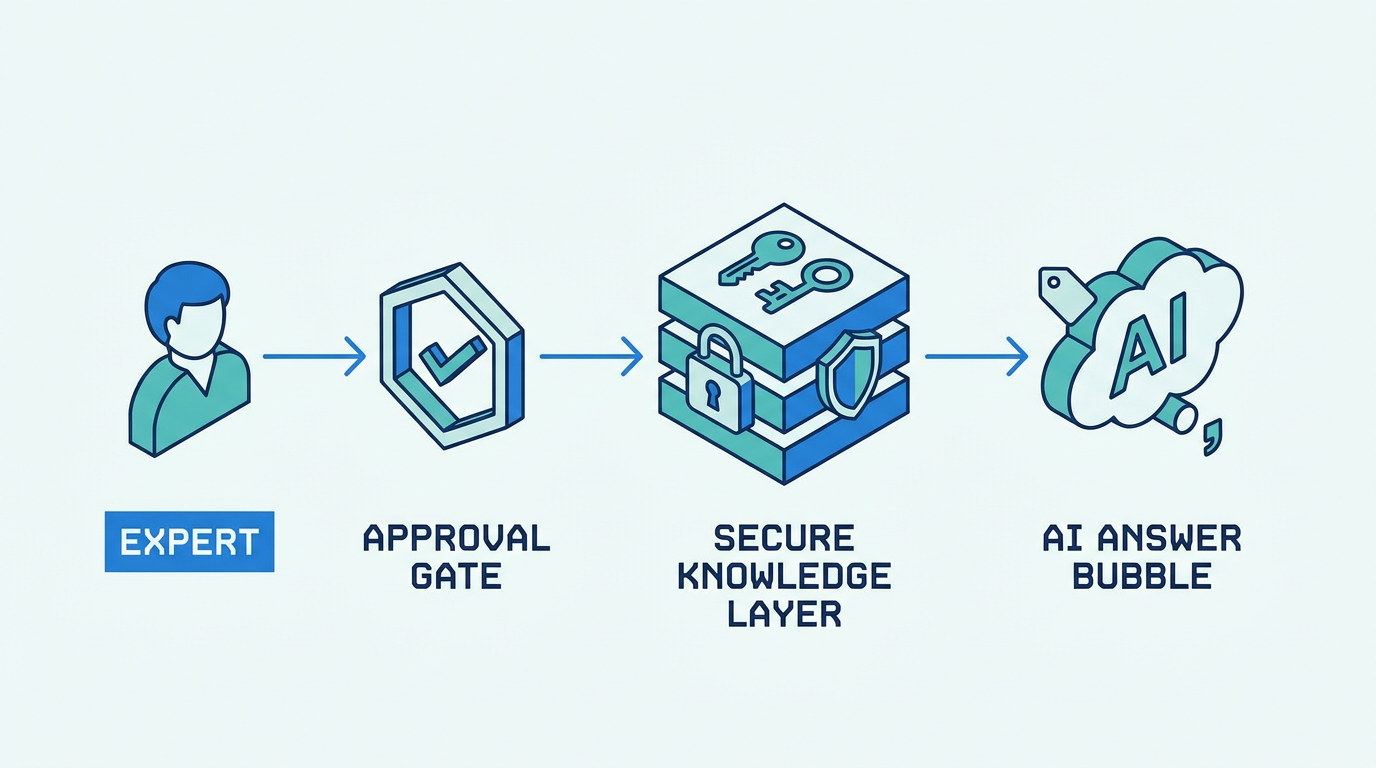
This is where a governed knowledge layer picks up. Sovrinty turns SME-approved knowledge into answers your business can prove: grounded only in approved sources, scoped to the reader through attribute-based access control (ABAC) so people only see what they are cleared to see, and traceable back to the exact source an expert signed off on. Knowledge that ages out expires and is pulled from circulation automatically, so an SME's contribution never quietly goes stale, the same reassurance that made them willing to share in the first place. The expert approves once, and governance keeps the answer trustworthy from then on.
If your experts' hard-won knowledge still lives in their heads and inboxes, the fix is a capture process they will actually use, paired with governance that keeps what they share provable and current. See how Sovrinty turns approved SME knowledge into governed, AI-ready answers by requesting a demo.
FAQ
Common questions
What is tribal knowledge?
Tribal knowledge is the unwritten, experience-based know-how that lives in employees' heads rather than in documented systems. It includes the workarounds, edge cases, and judgment calls experts apply without thinking, and it is easily lost when they leave.
What is the difference between tribal knowledge and institutional knowledge?
Institutional knowledge is the broader pool of understanding an organization holds collectively, while tribal knowledge is the unwritten slice held by a few individuals or a single team. Tribal knowledge is more fragile because it is undocumented and tied to specific people.
Is the term tribal knowledge offensive?
Some teams find the term inappropriate and prefer alternatives such as institutional knowledge, tacit knowledge, or undocumented know-how. The concept is the same regardless of the label, so use the wording that fits your organization's culture.
What is the difference between tribal knowledge and tacit knowledge?
Tacit knowledge is the academic term for know-how that is hard to articulate or write down, such as skill and intuition. Tribal knowledge is the workplace term for undocumented expertise held by specific people or teams; much of it is tacit.
How do you capture tribal knowledge from SMEs?
Make contributing low-effort: accept recorded calls, rough notes, or diagrams instead of polished writing, tie updates to real events rather than reminders, and let the expert approve the final version. Then govern what you capture so it stays accurate and access-controlled.
Why is tribal knowledge a problem for AI?
AI systems can only draw on knowledge that is documented, current, and permissioned. Tribal knowledge is none of those, so it stays invisible to the AI or, worse, surfaces as outdated guidance. Capturing and governing it is what makes it safe for AI to use.


