
What an AI audit trail is, and why it matters now
An AI audit trail is a complete, tamper-evident record of how an AI system produced a specific answer: which sources it drew on, which version of each source was live at the time, who approved that content, and how strong the supporting evidence was. In regulated industries such as financial services, healthcare, defense, and pharma, that record is the line between an output you can defend to an auditor and one you can only hope is correct.
The pressure is no longer theoretical. Gartner forecasts that 60% of enterprise AI projects will be abandoned through 2026 because organizations lack AI-ready, governed data. Meanwhile the EU AI Act carries penalties of up to EUR 35 million or 7% of global annual turnover for the most serious violations, and its transparency and record-keeping obligations for high-risk systems assume you can show your work. An AI audit trail is how you show it.
What regulators and auditors actually ask for
Auditors rarely ask whether your model is accurate. They ask narrower, harder questions. Where did this specific answer come from? Was that source approved, and by whom? Was it current on the date the answer was given? Can you reproduce the answer months later and show it has not been quietly altered? The NIST AI Risk Management Framework and ISO/IEC 42001 both push in the same direction, treating traceability and documentation as core controls rather than optional hygiene.
Anatomy of a trustworthy AI audit trail
A trustworthy trail is not one feature. It rests on four properties that work together, each answering a question an auditor will eventually ask.
Source-level provenance
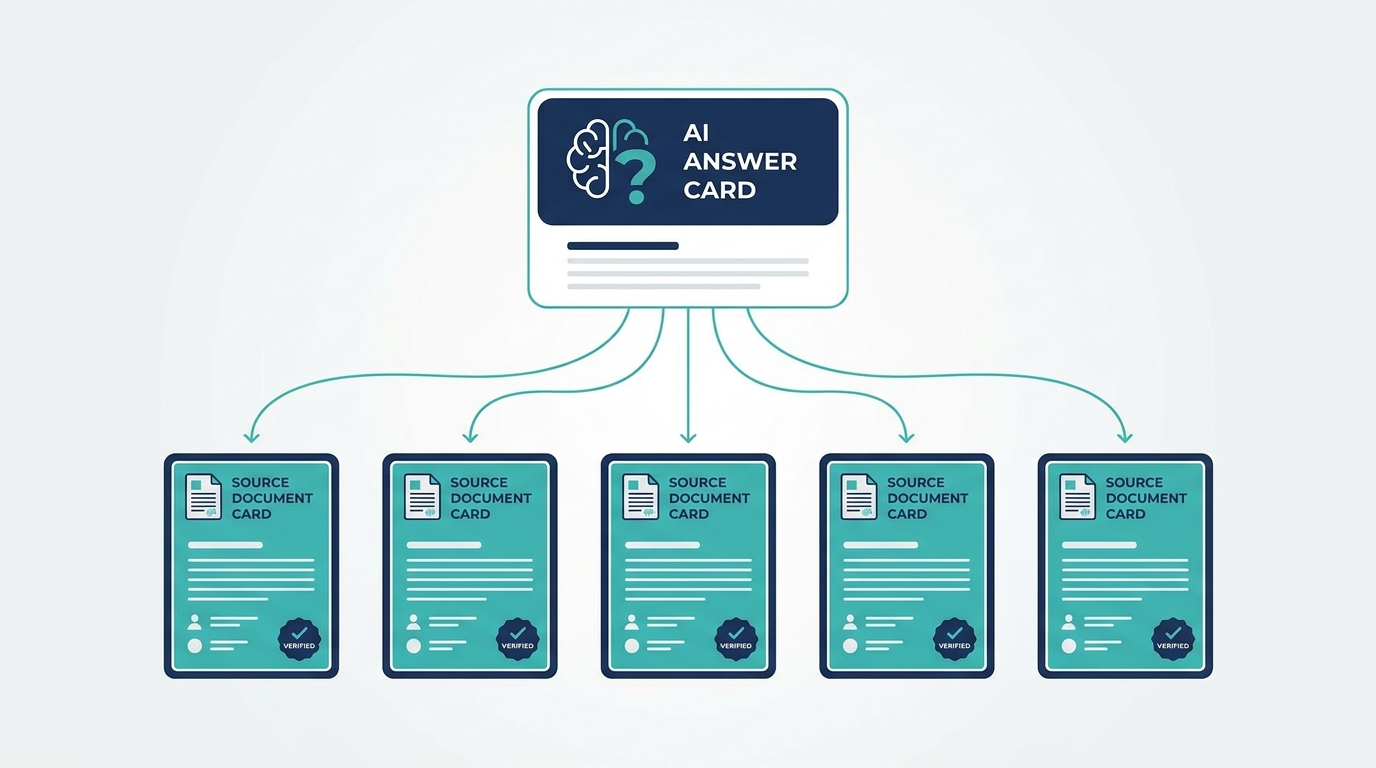
Every sentence in an answer should trace to an identifiable, approved source, not to a general model impression. Sovrinty compiles approved sources directly into the retrieval query, so answers are assembled from governed material rather than filtered afterward. Unsourced sentences are removed before the answer is served, which means the citation you see is the citation the system actually used.
Immutable version history
An audit trail is only as trustworthy as its resistance to quiet edits. Content should be versioned and never overwritten, with each version hashed so any drift is detectable. When a document changes, the prior version stays on the record rather than disappearing, so you can reconstruct exactly what an answer relied on at any past date.

Currency you can prove
Stale knowledge is a quiet failure mode: the answer looks confident while resting on a policy that changed last quarter. Time-to-live rules and a daily scheduled job pull expired items out of circulation automatically, so an answer's sources are current by construction rather than by someone remembering to check. A strong trail records not only what was cited, but that the citation was live at the moment it was used.
Honest confidence
A defensible trail separates how relevant a result is from how much the system trusts it. Sovrinty derives confidence from the raw semantic evidence before any ranking boosts are applied, so a high-confidence label reflects the strength of the underlying sources rather than a tuned score. That distinction matters the moment a reviewer asks why the system was sure.
Bolt-on logging vs governance by architecture
Most teams reach for logging first. Capture prompts and responses, store them, and call it an audit trail. Logging tells you what happened. It does not tell you whether what happened was allowed, sourced, or current. The gap shows up the moment an auditor asks a question the logs cannot answer.
| CAPABILITY | BOLT-ON REQUEST LOGGING | GOVERNANCE BY ARCHITECTURE |
|---|---|---|
| Records prompts and outputs | Yes | Yes |
| Ties each answer to approved sources | No | Yes |
| Preserves the source version used | Rarely | Yes |
| Flags stale or expired sources | No | Yes |
| Enforces access rules on the answer | No | Yes |
| Reconstructs a past answer on demand | No | Yes |
How to evaluate an AI audit trail
Treat the audit trail as an architectural property, not a report you export after the fact. Ask whether access control is enforced at the AI layer at a single, fail-loud choke point rather than bolted on per application. Attribute-based access control at the retrieval layer and zero-exfiltration handling of your data are table stakes for regulated deployments; the questions that separate vendors are about provenance, version history, and currency. The same trail underpins sector-specific obligations, from financial services to healthcare and defense.
If your AI can produce answers but cannot prove where they came from, you are carrying audit risk you cannot see. See how Sovrinty builds provenance, immutable history, and currency into the architecture, so every answer is one you can defend. Book a demo to see it applied to your regulated use case.
FAQ
Common questions
What is an AI audit trail?
An AI audit trail is a tamper-evident record of how an AI system produced a given answer, including the sources used, the version of each source, who approved it, and the strength of the supporting evidence.
Why do regulated industries need an AI audit trail?
Because auditors and frameworks such as the EU AI Act and the NIST AI Risk Management Framework require organizations to show where an answer came from and prove it was sourced and current, rather than simply asserting the model is accurate.
How is an AI audit trail different from logging prompts and responses?
Logging records what was asked and answered. An audit trail additionally ties each answer to approved sources, preserves the version used, flags stale sources, and enforces access rules, so it can withstand a request to reproduce a past answer.
Does an AI audit trail prove the AI is always correct?
No. It proves an answer was assembled only from approved sources that were current and permitted, and it makes the supporting evidence inspectable. It documents grounding, not infallibility.
What should I look for when evaluating an AI audit trail?
Look for source-level provenance, immutable and hashed version history, automatic expiry of stale content, access control enforced at the AI layer, and the ability to reconstruct any past answer.
Does an AI audit trail help with EU AI Act compliance?
It supports the record-keeping and transparency obligations the EU AI Act places on high-risk systems, though full compliance also depends on broader governance, risk management, and documentation practices.


