
Why AI governance keeps failing at the enforcement layer
Here is the uncomfortable claim: most AI governance programs are theater. Not because the people running them lack rigor, but because the controls live in the wrong place. A policy that says the model must not expose material non-public information is a sentence in a PDF. The model cannot read it. When an analyst asks a question at 4:55pm on a Friday, nothing in that document reaches into the retrieval pipeline to stop a restricted document from landing in the answer.
Governance that a system cannot enforce is not governance. It is documentation of intent. Regulators have started to notice the difference, and the gap between what your policies promise and what your systems actually do is where liability now lives.
The paper-versus-code gap
The dominant model of AI governance is borrowed from an earlier era of compliance: write the policy, train the staff, audit annually. That works when humans are the control surface. It breaks when the control surface is a language model retrieving from thousands of documents in milliseconds.
Consider what a typical governance framework specifies versus what actually has to happen at runtime.
| GOVERNANCE POLICY SAYS | RUNTIME SYSTEM MUST DO |
|---|---|
| Restrict data by clearance and role | Evaluate attributes on every retrieval before an answer is composed |
| Keep an audit trail of AI decisions | Record the exact sources behind each specific answer, immutably |
| Prevent stale information in outputs | Detect and suppress superseded documents at query time |
| Do not let data leave the trust boundary | Enforce zero-exfiltration on both the data and the model |
The left column is where most organizations stop. The right column is the actual work, and it cannot be done by a quarterly review. It has to be enforced by the architecture itself, on every single query, or it is not enforced at all.
What enforcement at the AI layer looks like
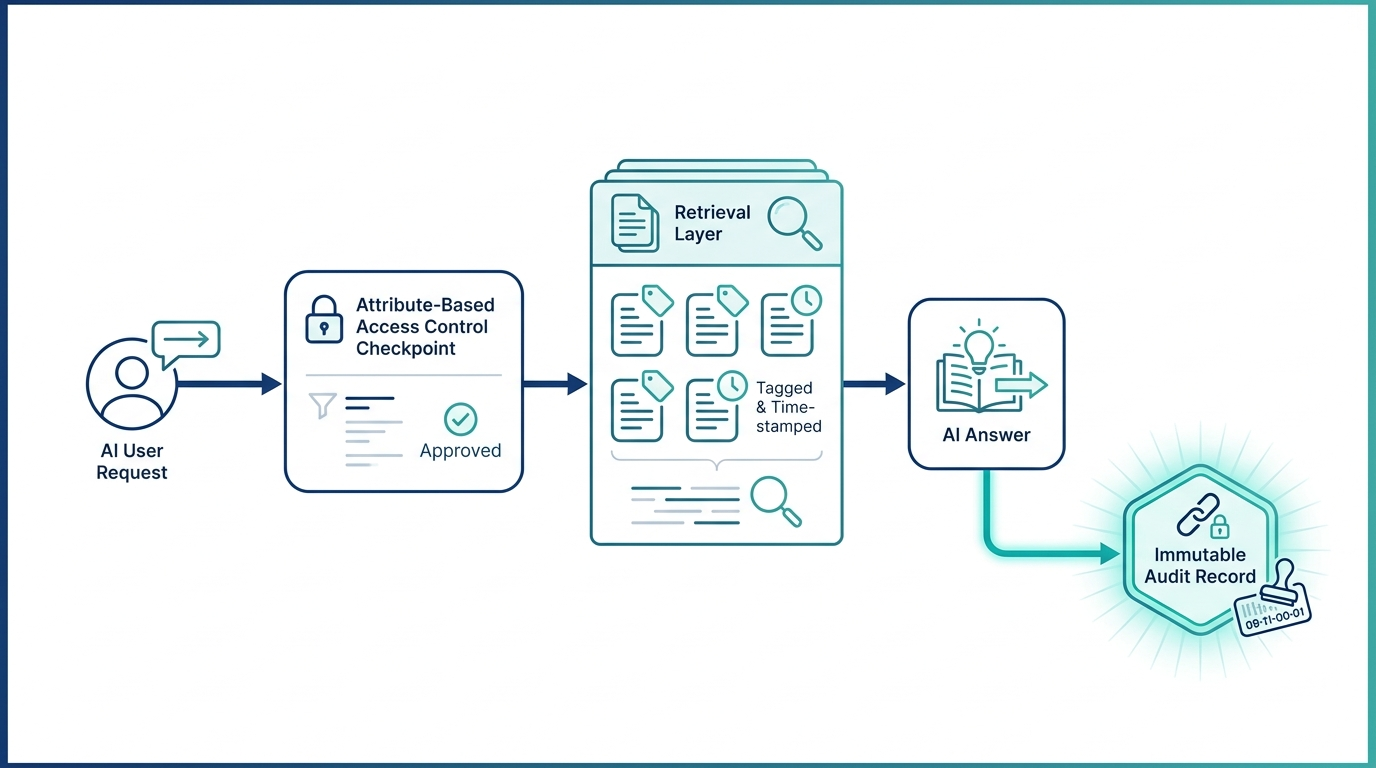
Attribute-based access control, or ABAC, is well understood in data engineering. The shift that regulated AI demands is moving that enforcement up to the AI layer, so that clearance, role, and data sensitivity are evaluated at the moment of retrieval rather than assumed from an upstream permission someone set months ago. The NIST AI Risk Management Framework frames this as making risk controls measurable and continuous rather than one-time. Continuous is the operative word.
Provenance you can prove
An audit trail that says the AI answered at 10:42am is useless in an examination. What a regulator or an internal risk officer needs is the specific chain: this answer was built from these three documents, at these versions, retrieved under this user's clearance. Sovrinty calls this the Golden Spike, an immutable per-answer record of exactly what produced each response. That is the difference between an answer your business hopes is right and answers your business can prove.
Verbatim enforcement and the staleness cascade
Two failure modes rarely appear in governance policies because they are invisible until they cause harm. The first is paraphrase drift, where a model restates a regulated disclosure in words that subtly change its meaning; verbatim enforcement pins the output to the approved language. The second is the staleness cascade, where one outdated source propagates through downstream answers long after it was retired. Catching either requires logic that runs at query time, not a reviewer reading transcripts weeks later.
The stakes are now regulatory, not reputational
For years the argument for AI governance was brand risk. That framing is obsolete. The EU AI Act carries penalties of up to EUR 35 million or 7 percent of global annual turnover for the most serious violations. Meanwhile Gartner forecasts that 60 percent of enterprise AI projects will be abandoned through 2026 for lack of AI-ready, governed data. The projects that survive will be the ones that treated governance as an enforcement problem from the start, not a documentation exercise bolted on before launch.

This is especially acute in defense, financial services, and healthcare, where the cost of a single ungoverned answer is measured in fines, sanctions, or patient harm rather than embarrassment. Sovrinty's approach to zero-exfiltration and ABAC at the AI layer exists because in these sectors, we have a policy is not a defense a regulator accepts.
Enterprise AI governance as an architectural choice
The reframe is simple to state and hard to retrofit: enterprise AI governance is not a program you run alongside your AI systems. It is a property of the systems themselves. Every control your policy promises should have a corresponding mechanism that enforces it at runtime, produces evidence automatically, and fails safe when it cannot. If you cannot point to the code path that enforces a given rule, you do not have that control. You have a wish.
Organizations that internalize this stop asking is our AI compliant and start asking can our AI prove it was compliant on this specific answer. That is a question architecture can answer, and paper cannot.
If your AI governance still lives mostly in documents, it is worth seeing what enforcement at the AI layer looks like in practice. Book a Sovrinty demo to walk through provenance, verbatim enforcement, and ABAC applied to your own regulated workflows.
FAQ
Common questions
What is AI governance?
AI governance is the set of controls that determine what an AI system can access, produce, and prove. Effective AI governance is enforced at runtime on every query, not just documented in policy, so that access rules, provenance, and data boundaries hold at the moment an answer is generated.
Why do most AI governance programs fail?
They fail because the controls live in policy documents the AI system never reads. A model cannot enforce a rule written in a PDF, so unless clearance, provenance, and data boundaries are enforced in the architecture at query time, the governance exists only on paper.
What is an AI governance framework?
An AI governance framework is a structured set of principles and controls for managing AI risk, such as the NIST AI Risk Management Framework. Its value depends on whether each principle maps to a runtime mechanism that actually enforces it, rather than a control that is only reviewed periodically.
How is AI governance actually enforced at the AI layer?
Enforcement happens through attribute-based access control evaluated on every retrieval, immutable per-answer audit trails that record the exact sources behind each response, verbatim enforcement of approved language, and zero-exfiltration boundaries on both data and model.
What is enterprise AI governance?
Enterprise AI governance is the practice of treating governance as a property of the AI systems themselves rather than a separate program. Every policy promise has a corresponding runtime mechanism that enforces it, generates evidence automatically, and fails safe when it cannot.
Does the EU AI Act require an AI audit trail?
The EU AI Act requires record-keeping and traceability for high-risk AI systems, with penalties up to EUR 35 million or 7 percent of global turnover for serious violations. In practice this means keeping an immutable audit trail that ties each AI output to the specific data and versions behind it.


