
Sovereign AI is an approach to deploying artificial intelligence in which the data, the models, and the governance controls all remain under the operating organization's jurisdiction and control, rather than being surrendered to a third-party platform. For banks, defense agencies, and healthcare systems, that distinction decides whether AI is usable at all. If a large language model cannot be prevented from leaking regulated data, and if its answers cannot be traced back to an authoritative source, the technology stays trapped in pilots. This is why Gartner forecasts that 60% of enterprise AI projects will be abandoned through 2026 for lack of AI-ready, governed data.
The fix is not a better prompt or a bigger model. It is an architecture that treats control, provenance, and model independence as first-class requirements.
What sovereign AI means for regulated industries
Sovereign AI is often confused with simply hosting a model on your own servers. Location matters, but it is only one layer. True sovereignty means you retain authority over four things at once: where inference happens, which model processes each request, who can access which knowledge, and whether every answer can be audited after the fact.
Contrast this with the default posture of most commercial AI tools, where prompts and documents flow to an external endpoint, access is governed at the document store rather than the AI layer, and answers arrive with no verifiable link to a source. For a regulated enterprise, that posture is a compliance incident waiting to happen. The EU AI Act sets penalties as high as EUR 35M or 7% of global turnover for violations, and the NIST AI Risk Management Framework makes traceability and accountability core to trustworthy AI. Sovereign AI is how organizations meet those expectations without abandoning the technology.
Sovereignty, data sovereignty, and AI sovereignty
These terms overlap but are not identical. Data sovereignty concerns where data physically resides and which laws govern it. AI sovereignty extends that principle to the model and inference layer: not just where the data sits, but who controls the intelligence acting on it. Sovereign AI is the operational discipline that unites both, ensuring that the knowledge layer feeding your models stays governed end to end.
Why model-agnostic architecture is non-negotiable
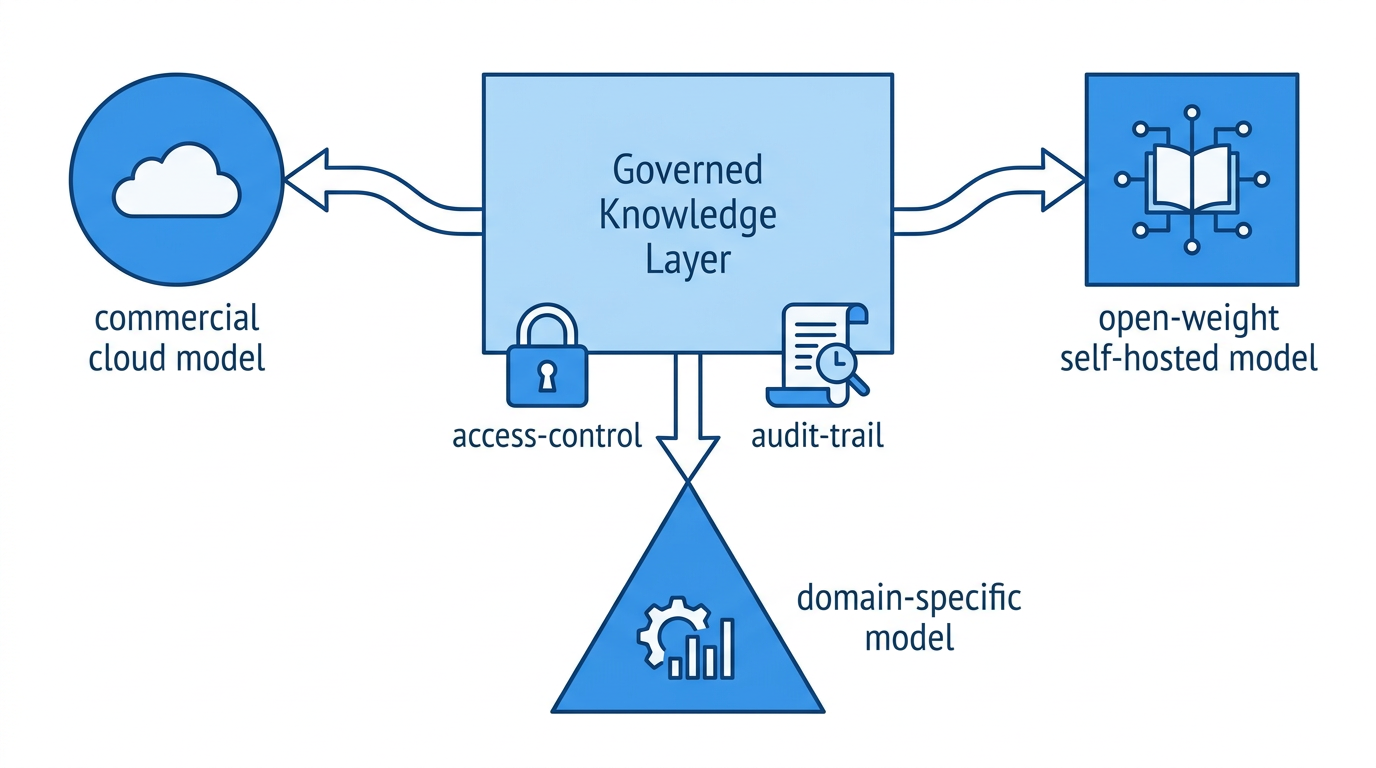
A sovereign strategy that locks you into a single vendor's model is not sovereign. Model capabilities, prices, and licensing terms shift constantly, and regulatory approval for a given model varies by jurisdiction and use case. A bring-your-own-model (BYOM) approach lets you route each request to the model that fits the security tier, the regulatory context, and the budget, whether that is a frontier commercial model, an open-weight model running in your own environment, or a domain-specific model your team fine-tuned.
Model-agnostic architecture also protects the investment you make in governance. When your access controls, provenance, and audit trail live in the knowledge layer rather than inside one model's API, swapping models becomes a configuration change instead of a re-platforming project. Sovrinty's model-agnostic knowledge layer is built on exactly this principle, so the controls travel with your data, not with a vendor.
| CAPABILITY | TYPICAL AI TOOL | SOVEREIGN AI APPROACH |
|---|---|---|
| DATA HANDLING | Prompts sent to external endpoint | Zero-exfiltration, stays in your environment |
| ACCESS CONTROL | At the document store | ABAC enforced at the AI layer |
| MODEL CHOICE | Single vendor lock-in | Bring-your-own-model, routed per request |
| ANSWER PROVENANCE | None, or a citation guess | Immutable per-answer audit trail |
| COMPLIANCE POSTURE | Reactive | Answers your business can prove |
How to make sovereign AI answers provable
Control over infrastructure is necessary but not sufficient. The harder problem is trust in the output. Three mechanisms turn a governed deployment into one that produces defensible answers.
First, zero-exfiltration ensures that regulated content is never transmitted to an uncontrolled endpoint during inference. Second, attribute-based access control (ABAC) enforced at the AI layer means a user only ever receives answers synthesized from knowledge they are cleared to see, closing the gap that document-level permissions leave open. You can read how Sovrinty implements both on the security page.
Third, and most important for regulated work, every answer needs a provenance record. Sovrinty calls this the Golden Spike: an immutable, per-answer audit trail that captures exactly which sources, model, and access context produced a given response, with verbatim enforcement so critical passages are quoted rather than paraphrased. This is what lets a compliance officer reconstruct any AI-assisted decision months later, and it is the difference between AI you hope is right and AI your business can prove.

Guarding against the staleness cascade
Governed knowledge is not static. When a policy, a rate, or a clinical guideline changes, every downstream answer that relied on the old version becomes wrong. A sovereign knowledge layer tracks these dependencies and flags the staleness cascade before it reaches a customer or a regulator, so your AI ages with your business instead of drifting away from it. Financial institutions can see this pattern applied in Sovrinty's financial services solutions.
Regulated organizations do not have the luxury of treating AI governance as a later phase. If your teams are evaluating how to deploy sovereign AI without sacrificing model flexibility or auditability, contact the Sovrinty team to discuss your requirements and see how a governed, model-agnostic knowledge layer fits your compliance obligations: talk to our team.
FAQ
Common questions
What is sovereign AI?
Sovereign AI is an approach to deploying AI where the data, models, and governance controls all stay under the operating organization's control and jurisdiction. It combines controlled inference, access control at the AI layer, and per-answer provenance so regulated organizations can use AI without surrendering data or auditability.
Is sovereign AI the same as data sovereignty?
No. Data sovereignty concerns where data resides and which laws govern it. Sovereign AI extends that principle to the model and inference layer, governing not just the data but the intelligence acting on it and the answers it produces.
What does model-agnostic AI mean?
Model-agnostic AI, also called bring-your-own-model, means your governance and knowledge layer works with any model rather than a single vendor's. Each request can be routed to the model that fits the security tier, regulatory context, and budget, and you can swap models without rebuilding your controls.
Does sovereign AI require on-premise deployment?
Not necessarily. Where inference runs is one layer of sovereignty, but true sovereignty also requires control over model choice, access enforcement, and provenance. Sovereign AI can run on-premise, in a private cloud, or in a controlled environment, as long as data is not exfiltrated and answers stay auditable.
How does sovereign AI support regulatory compliance?
By enforcing zero-exfiltration, applying attribute-based access control at the AI layer, and recording an immutable per-answer audit trail, sovereign AI produces answers an organization can prove. That traceability aligns with frameworks like the NIST AI RMF and helps address obligations under the EU AI Act.
Why does answer provenance matter for regulated AI?
Without provenance, an AI answer cannot be traced to an authoritative source or reconstructed later. Regulated decisions require that audit path. A per-answer trail capturing the sources, model, and access context lets compliance teams verify any AI-assisted decision after the fact.


