
Enterprise AI adoption has outrun enterprise AI oversight. Gartner forecasts that 60 percent of enterprise AI projects will be abandoned through 2026 for lack of AI-ready data, and far fewer organizations can say who approved the model, what data it touches, or how an output would be defended in front of a regulator. AI governance closes that gap. It is the set of policies, controls, and evidence that makes AI systems accountable to the business, to auditors, and to the law. This guide covers what a working AI governance framework contains, the regulations forcing the issue, and how regulated enterprises are operationalizing governance without stalling adoption.
What an AI Governance Framework Must Actually Do
A framework document that lives in a slide deck is not governance. A working AI governance framework does four jobs, continuously and provably.
Policy: decide what is allowed
Governance starts with explicit decisions: which models are approved, which use cases are permitted, what data classifications can reach which systems, and who signs off on exceptions. In regulated industries this must map to existing obligations; a bank's model risk management policy under SR 11-7, a defense contractor's ITAR boundary, a pharma company's GxP requirements.
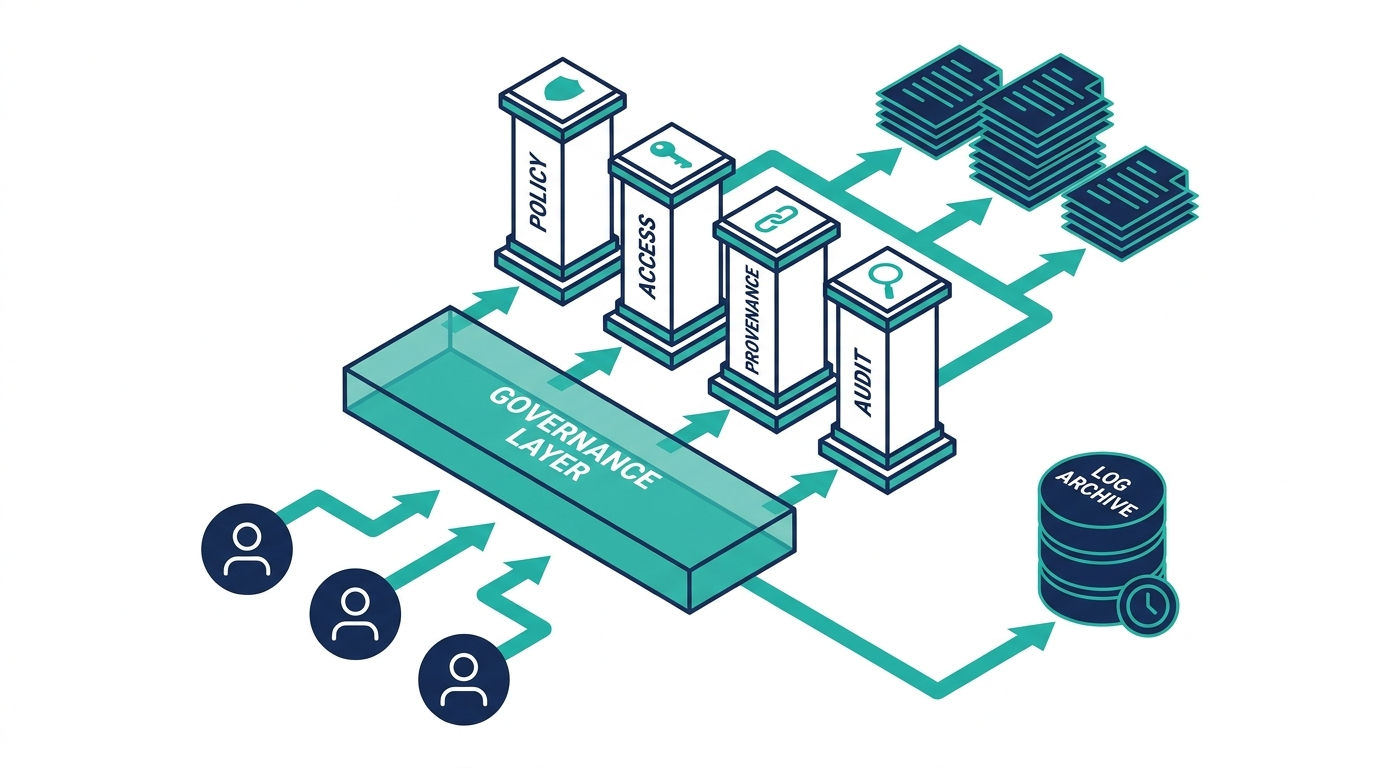
Access: enforce who can ask what
AI systems collapse access boundaries by default. A model with retrieval over company documents will happily surface an M&A memo to an intern unless permissions follow the data into the AI layer. Enforcing document-level, attribute-based access control inside AI workflows, so retrieval and answers are gated by clearance rather than just the document store, is where most governance programs succeed or fail.
Provenance: prove where answers come from
When an AI answer influences a regulated decision, "the model said so" is not a defensible position. Provenance means every answer traces back to an approved source, with citations that are verbatim rather than paraphrased approximations, and an immutable audit trail linking source, model, and approver for every line.
Audit: keep evidence regulators can inspect
Every prompt, retrieval, and output needs a record. Auditors do not accept intentions; they accept logs. An audit trail that reconstructs who asked what, what sources were used, and what the system returned is the difference between a finding and a pass.
The Regulations Driving AI Governance in 2026
Three instruments now shape most enterprise AI governance programs. The EU AI Act entered into force in August 2024, with obligations phasing in through 2027; high-risk system requirements include logging, human oversight, and technical documentation, with penalties reaching 35 million euros or 7 percent of global turnover, whichever is greater. The NIST AI Risk Management Framework is voluntary but has become the de facto vocabulary for US enterprises and federal suppliers. ISO/IEC 42001 gives organizations a certifiable AI management system standard, and early adopters are using certification as a procurement differentiator.
The table below maps the four framework pillars to what oversight bodies actually request.
| PILLAR | WHAT REGULATORS ASK | EVIDENCE THAT SATISFIES |
|---|---|---|
| Policy | Which uses are permitted and who approved them | Approved model and use-case register with sign-offs |
| Access | How restricted data is protected in AI workflows | Document-level permissions enforced at retrieval time |
| Provenance | Why the system produced this output | Verbatim citations resolving to approved sources |
| Audit | What happened, when, and by whom | Immutable logs of prompts, retrievals, and outputs |

AI Governance Tools: Build, Buy, or Inherit the Risk
Searches for AI governance tools have grown sharply, and the market has responded with two broad categories. Process tools manage inventories, risk assessments, and workflow approvals; they document governance. Enforcement tools sit in the AI request path and apply policy at runtime; they perform governance. Most regulated enterprises need both, but the enforcement layer is the harder problem, because it must intercept every interaction between users, models, and data.
Why sovereignty is becoming a governance requirement
For defense, financial services, and healthcare organizations, governance increasingly extends to sovereignty: control over where models run and where data flows. A governance framework loses credibility if the underlying AI stack exfiltrates prompts to infrastructure the enterprise cannot inspect. This is driving interest in model-agnostic, bring-your-own-model architectures with zero-exfiltration deployment, where the knowledge layer enforces policy regardless of which model sits underneath.
How to Stand Up AI Governance Without Stalling Adoption
The pattern that works in practice has three moves. First, form an AI governance committee with real authority; interest in this structure is surging, and for good reason, because a committee that owns the use-case register turns governance from a veto into a pipeline. Second, start with the highest-value regulated workflow rather than boiling the ocean; one governed deployment that survives an audit builds more organizational trust than a hundred-page policy. Third, instrument from day one; retrofitting audit trails onto an ungoverned AI estate is far more expensive than logging from the first query.
Organizations that treat governance as an enabler are shipping AI into regulated workflows faster than those that treat it as paperwork, because every approval conversation starts from evidence instead of assurances.
If you are building an AI governance framework for a regulated environment and want to see what enforced provenance and a query-level audit trail look like in practice, request a Sovrinty demo and walk through a governed deployment end to end.
FAQ
Common questions
What is an AI governance framework?
An AI governance framework is the set of policies, controls, and evidence an organization uses to keep AI systems accountable. In practice it covers four functions: policy (what is allowed), access (who can ask what), provenance (where answers come from), and audit (proof of what happened).
What is the difference between AI governance and AI compliance?
Compliance is meeting specific external requirements like the EU AI Act; governance is the broader internal system that makes compliance achievable and provable. Strong governance typically satisfies multiple regulations at once, while compliance-only approaches tend to fragment by jurisdiction.
What does an AI governance committee actually do?
It owns the approved model and use-case register, reviews new AI use cases against policy, handles exceptions, and reports AI risk to leadership. The most effective committees function as an approval pipeline rather than a veto board.
Which regulations require AI governance in 2026?
The EU AI Act is the most prescriptive, with high-risk obligations phasing in through 2027. In the US, NIST AI RMF adoption is expected by many federal buyers, and sector rules like SR 11-7 in banking apply. ISO/IEC 42001 is voluntary but increasingly requested in procurement.
What should I look for in AI governance tools?
Distinguish documentation tools (inventories, assessments, approvals) from enforcement tools (runtime policy, access control, audit logging in the AI request path). Regulated enterprises generally need enforcement in place before scaling, because logs and access controls cannot be retrofitted onto past activity.
How do you audit an AI system's answers?
Each answer must be traceable: the prompt, the retrieved sources, the permissions checked, and the output, all logged immutably. Verbatim citations that resolve to approved source documents let an auditor verify any individual answer end to end.


