
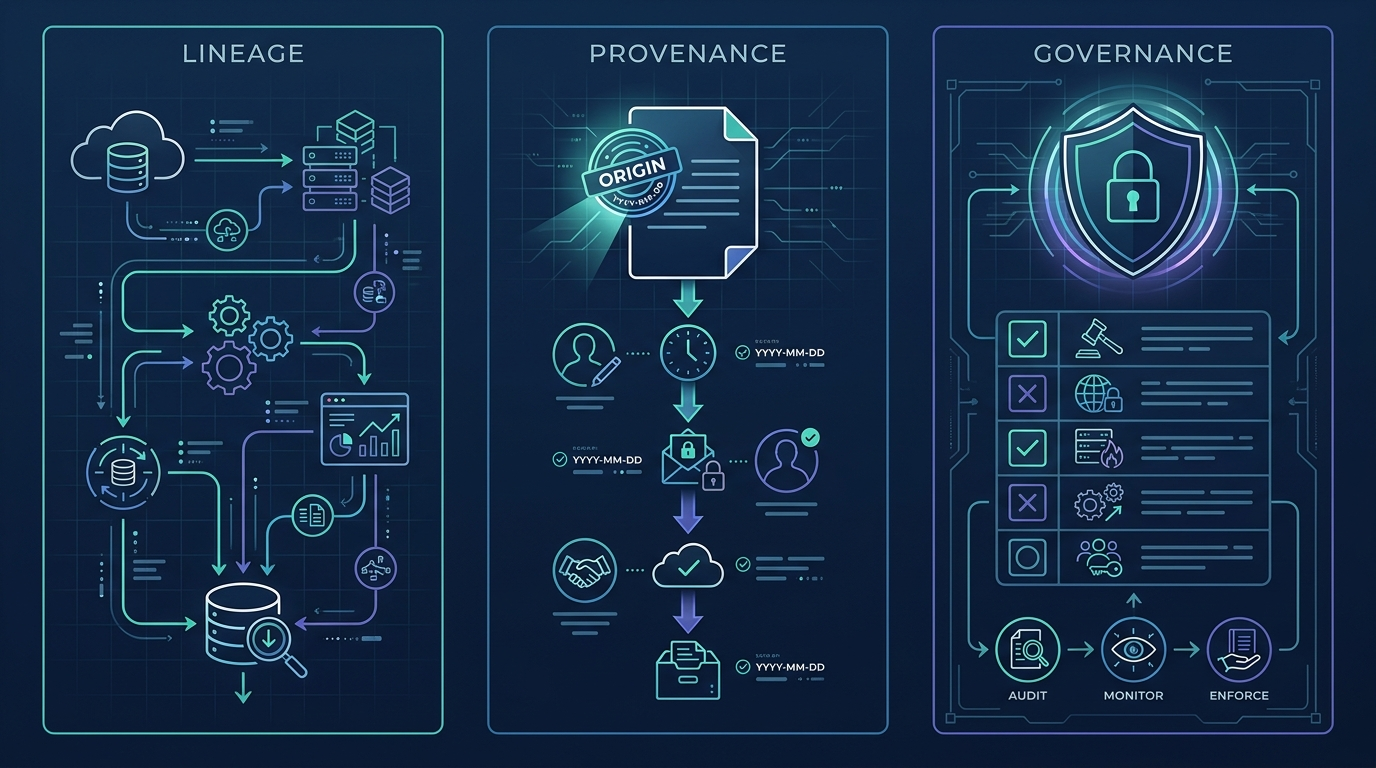
Data lineage is the documented record of how data moves and transforms across systems, from its original source to its final use. For AI systems, it traces every input behind a generated answer, so teams can see which sources, versions, and transformations shaped an output, and prove that trail when regulators or auditors ask.
| ASPECT | DATA LINEAGE | DATA PROVENANCE | DATA GOVERNANCE |
|---|---|---|---|
| Focus | How data moves and transforms across systems | Where data originated and its history of custody | Policies and controls for how data is used |
| Key question | What path did this data take? | Where did this come from and can we trust it? | Who may use this and how? |
| AI relevance | Traces the inputs behind each answer | Confirms the source behind each answer | Enforces access and approval at the AI layer |
| Audit value | Reconstructs the full path of an output | Verifies the authority of a cited source | Shows controls were applied consistently |
Why data lineage matters for AI in regulated industries
In defense, financial services, and healthcare, an AI answer is only as defensible as the trail behind it. When a model produces a recommendation a regulator questions, teams need to show exactly where the underlying information came from and how it was processed. Gartner forecasts that 60 percent of enterprise AI projects will be abandoned through 2026 for lack of AI-ready data, and weak lineage is a core reason: without a clear path from source to output, organizations cannot trust, reproduce, or defend what their AI produces. The EU AI Act reinforces this, with penalties reaching EUR 35 million or 7 percent of global turnover for the most serious violations, and record-keeping obligations that assume you can reconstruct how a high-risk system reached its decisions.
This is why lineage sits at the center of governed AI for regulated industries. It converts a black-box output into a reviewable chain of evidence, which is the difference between an AI pilot and a system that can operate inside a compliance regime.
What data lineage tracks in an AI pipeline
A useful lineage record follows information through every stage between a source document and the answer a user reads. In a retrieval-based AI system, that means capturing far more than the final response.
Source and version
Lineage starts by identifying the exact document, record, or dataset an answer draws on, including its version. A policy updated last week and the version it replaced are different sources, and an answer built on the wrong one is a compliance risk. Tracking version lets teams flag when an answer rests on information that has since changed or expired.
Transformations and retrieval
Between source and answer, data is chunked, embedded, retrieved, and ranked. Lineage records which passages were retrieved, how they were scored, and which ones actually informed the generated text. This is what separates a plausible-sounding answer from one you can trace back to approved, current material.
How data lineage supports AI audit and compliance
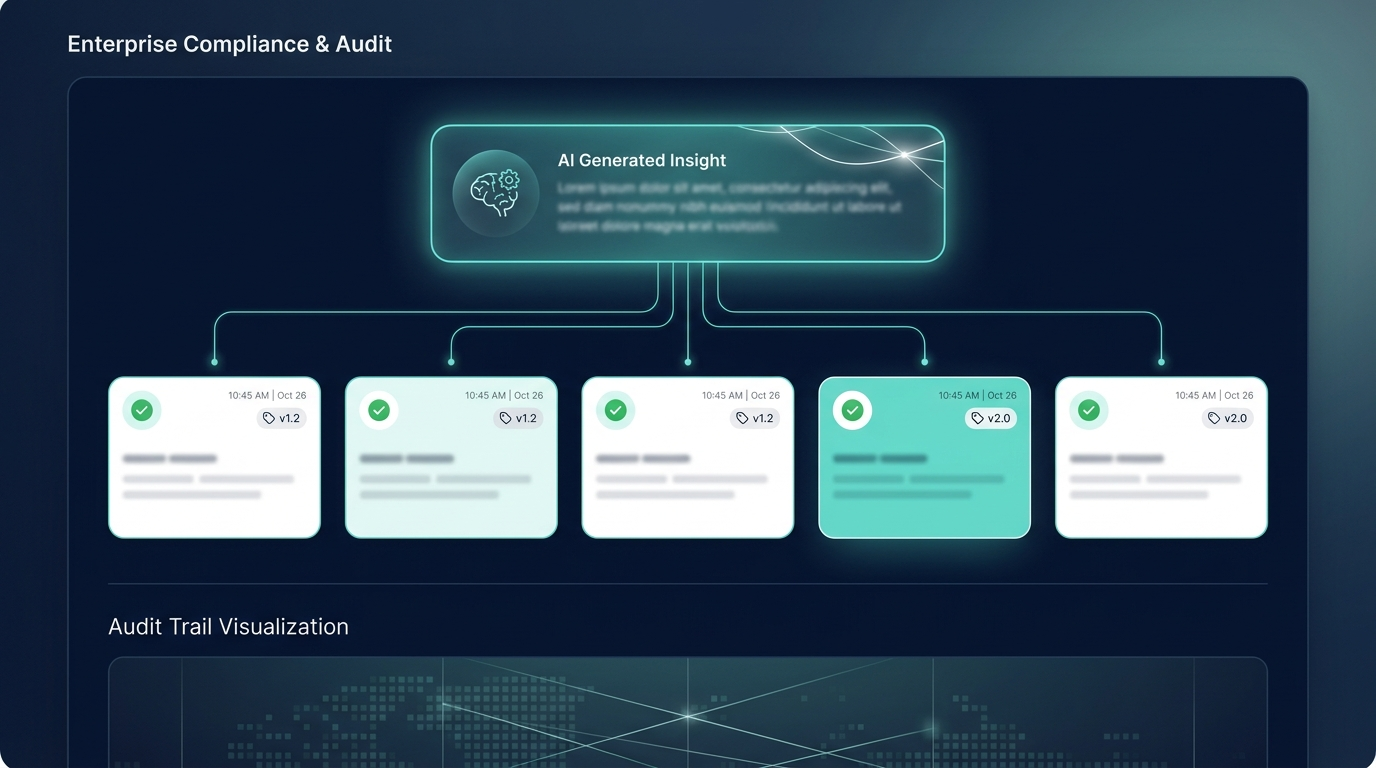
Auditors and regulators do not accept the claim that the model said so. They expect evidence. Data lineage produces that evidence by mapping each output to its inputs, satisfying record-keeping expectations in frameworks like the NIST AI Risk Management Framework and the ISO/IEC 42001 AI management system standard. Both emphasize traceability and documentation across the AI lifecycle.
Strong lineage also shortens investigations. When an incident occurs, teams can reconstruct the full path of a specific answer rather than re-deriving it, which reduces both time and legal exposure. It turns audit from a fire drill into a query.
Building data lineage into governed AI
Lineage bolted on after the fact is fragile. The durable approach is governance by architecture: capture lineage as answers are produced, not reconstructed later. Sovrinty grounds every answer in approved sources and keeps a traceable link from the response back to the material it cites, so the path from source to answer is available by design rather than assembled under deadline. Access is enforced at the AI layer through attribute-based controls, and knowledge that ages out is expired and pulled from circulation automatically, so answers reflect current, approved material rather than silently stale content. You can read more on the Sovrinty product page.
Because Sovrinty is model-agnostic, teams can bring their own model without losing the lineage record, and sovereignty controls keep source data from leaving the environment. Security and data sovereignty are the foundation lineage sits on: a trail is only trustworthy if the underlying data was never exposed or exfiltrated in the first place.
For regulated teams, data lineage is the practical bridge between AI ambition and audit-ready accountability. If you want to see how governed, traceable AI produces answers you can defend, book a Sovrinty demo.
FAQ
Common questions
What is data lineage in AI?
Data lineage in AI is the documented trail of how data moves from its original source through processing to a generated answer. It lets teams identify which sources and versions shaped an output and reproduce that path for review.
What is the difference between data lineage and data provenance?
Data lineage focuses on how data moves and transforms across systems, while data provenance focuses on where data originated and its history of custody. Lineage answers what path this took, provenance answers where this came from. Governed AI needs both.
Why is data lineage important for AI compliance?
Because auditors and regulators require evidence, not assurances. Data lineage maps each AI output to its inputs, satisfying record-keeping and traceability expectations in frameworks like the EU AI Act, NIST AI RMF, and ISO 42001.
What does data lineage track in an AI pipeline?
It tracks the source document and its version, the transformations applied such as chunking and embedding, which passages were retrieved and ranked, and which of those actually informed the final answer.
How does data lineage help with the EU AI Act?
High-risk AI systems under the EU AI Act carry record-keeping and traceability obligations. Data lineage provides the reconstructable path from source to decision those obligations assume, helping teams avoid penalties of up to EUR 35 million or 7 percent of global turnover.
What are data lineage tools for AI?
Data lineage tools capture and visualize how data flows through AI pipelines. The most useful ones record lineage as answers are produced and tie each response to the approved sources it cites, rather than reconstructing the trail after the fact.


