
Data provenance is the documented record of where a piece of information originated, who touched it, and how it changed on its way to a decision. For any organization deploying AI, that record is now the difference between an answer you can defend and one you simply hope is correct. When a model generates a response from your internal knowledge, provenance is what lets you trace that response back to a specific source, version, and access rule. This guide explains what data provenance is, how it differs from related concepts, and how to build it into an AI system that regulators, auditors, and customers will trust.
What Is Data Provenance?
Data provenance answers a deceptively simple question: can you prove where this came from? It captures the full origin story of a data point, including its source system, the transformations applied to it, the people or processes that modified it, and the timestamps for each step. In traditional analytics, provenance mattered mostly for debugging and reproducibility. In the age of generative AI, it has become a governance requirement, because a model that cannot cite its sources cannot be held accountable for its outputs.
Data Provenance vs Data Lineage
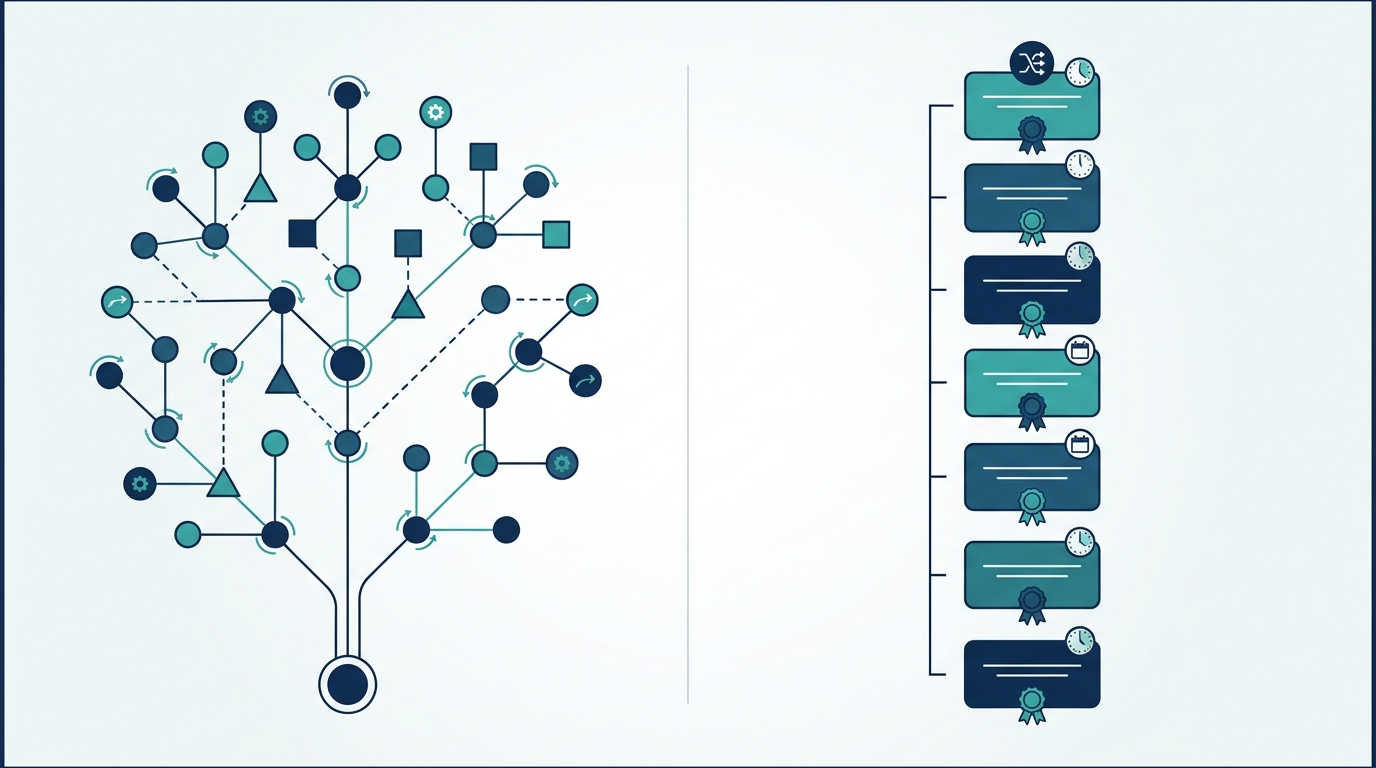
The two terms are often used interchangeably, but they answer different questions. Data lineage maps how data moves and transforms across pipelines, focusing on the path from source to destination. Data provenance is broader: it records not just the path but the origin, authorship, and context that establish trust and accountability. Lineage tells you how data got somewhere; provenance tells you whether you can rely on it. A mature AI knowledge layer needs both, but provenance is the layer that supports compliance and verifiable answers.
Why Data Provenance Matters for AI
Generative AI systems are probabilistic by design, which means they can produce fluent, confident answers with no inherent link to a trustworthy source. That is acceptable for brainstorming and unacceptable for a bank approving a loan, a hospital summarizing a patient record, or a defense contractor citing a classified specification. Without provenance, an AI answer is an assertion. With provenance, it becomes evidence. Gartner forecasts that 60 percent of enterprise AI projects will be abandoned through 2026 for lack of AI-ready data, and a large share of that failure traces back to organizations that could not trust or trace the inputs feeding their models.
Standards bodies have caught up to this reality. The NIST AI Risk Management Framework treats traceability and documentation as core to trustworthy AI, and emphasizes that organizations must be able to explain how a system reached its output. Provenance is the mechanism that makes that explanation possible, turning an opaque generation into an auditable chain of custody.
| CONCEPT | PRIMARY QUESTION | SCOPE | COMPLIANCE ROLE |
|---|---|---|---|
| Data provenance | Where did this come from and can we prove it? | Origin, authorship, versions, access context | Foundation for auditable, defensible AI answers |
| Data lineage | How did this data move and transform? | Pipeline paths and transformations | Supports debugging and impact analysis |
| Data governance | Who is allowed to do what with this data? | Policies, ownership, access rules | Sets the rules provenance and lineage enforce |
How to Build Data Provenance into Your AI Stack
Capture Provenance at the Answer Layer
Most provenance efforts stop at the data warehouse, but AI answers are generated at query time, far downstream of the warehouse. To be defensible, provenance has to be captured at the moment of the answer. Sovrinty records an immutable, per-answer audit trail called the Golden Spike, which ties every generated response to the exact sources, versions, and access decisions behind it. Because the trail is captured verbatim rather than reconstructed after the fact, it holds up under audit.
Enforce Access with ABAC
Provenance without enforcement is just a paper record. Attribute-based access control, applied at the AI layer rather than only at the database, ensures that the model can only draw on sources a given user is entitled to see, and that each answer's provenance reflects those permissions. This zero-exfiltration approach means sensitive inputs never leak into an answer they should not, and the provenance record proves it.

Data Provenance and the EU AI Act
Regulation is turning provenance from a best practice into a legal obligation. The European Union AI Act requires providers of high-risk AI systems to maintain detailed record-keeping and technical documentation that allow authorities to trace how a system operates. Non-compliance carries penalties of up to 35 million euros or 7 percent of global annual turnover, whichever is higher. Provenance records are among the most direct evidence a regulated organization can produce to demonstrate that its AI is operating within the rules.
For regulated sectors such as financial services, healthcare, and defense, the stakes are higher still, because every AI-assisted decision may later be examined by an auditor, a regulator, or a court. Building provenance in from the start is far cheaper than reconstructing it under subpoena.
If your AI needs to produce answers your business can prove, provenance cannot be an afterthought. See how Sovrinty captures verifiable provenance for every AI answer by booking a demo.
FAQ
Common questions
What is data provenance in AI?
Data provenance in AI is the recorded chain of custody for the information behind a model's output, showing the original source, versions, and access rules used to produce a specific answer. It lets you trace and defend AI responses rather than trusting them blindly.
What is the difference between data provenance and data lineage?
Data lineage maps how data moves and transforms across pipelines, while data provenance records where data originated, who authored it, and the context that establishes trust. Lineage explains the path; provenance establishes accountability.
Why is data provenance important for AI compliance?
Data provenance provides the traceable evidence regulators require, letting an organization show exactly which sources and permissions produced an AI answer. Frameworks like the NIST AI RMF and the EU AI Act treat this record-keeping as essential to trustworthy, high-risk AI.
What are data provenance tools?
Data provenance tools capture and store the origin, transformations, and access context of data as it flows into decisions and AI outputs. The most useful ones record provenance at the answer layer, not just in the data warehouse, so each generated response carries its own audit trail.
How does data provenance support the EU AI Act?
The EU AI Act requires high-risk AI providers to keep detailed records and documentation of how their systems operate, and provenance is the most direct way to satisfy that duty. It supplies the traceable proof authorities need to verify compliance.
Can you prove where an AI answer came from?
Yes, if provenance is captured at the moment the answer is generated. Sovrinty's per-answer Golden Spike audit trail ties each response to the exact sources, versions, and access decisions behind it, so the answer is verifiable rather than assumed.


