
Explainable AI (XAI) is a set of methods that make an AI system's outputs understandable to people, showing which inputs, data, and logic produced a given result. In regulated industries, explainability alone is not enough. Teams also need verifiable provenance that proves where each answer came from and who was cleared to see it.
What Explainable AI Means for Regulated Industries
Most explainable AI guidance was written for data science teams tuning models, not for compliance leaders defending an answer to a regulator. A feature attribution chart tells you which variables influenced a prediction. It does not tell an auditor whether the underlying document was current, whether the person who received the answer was authorized to see the source, or whether the same question asked tomorrow would return the same result. For banks, insurers, hospitals, and defense contractors, those are the questions that decide an audit.
Gartner forecasts that 60 percent of enterprise AI projects will be abandoned through 2026 because the data behind them is not AI-ready. Explainability sits on top of that data problem. If you cannot trust the source, an explanation of how the model used it is a well-documented guess.
Explainable AI vs Interpretability vs Provenance
These three terms are often used interchangeably, but they answer different questions. The table below separates them.
| APPROACH | QUESTION IT ANSWERS | WHAT IT PROVES | LIMIT FOR REGULATED AI |
|---|---|---|---|
| Interpretability | How does the model work internally? | Model logic is inspectable | Says nothing about a specific answer's sources |
| Explainable AI | Why did the model produce this output? | Which inputs drove the result | The explanation can be plausible yet unverifiable |
| Provenance | Where did this answer come from and who could see it? | The exact sources, version, and access at answer time | Requires capture at the AI layer, not after the fact |
Why Explainable AI Falls Short Without Provenance
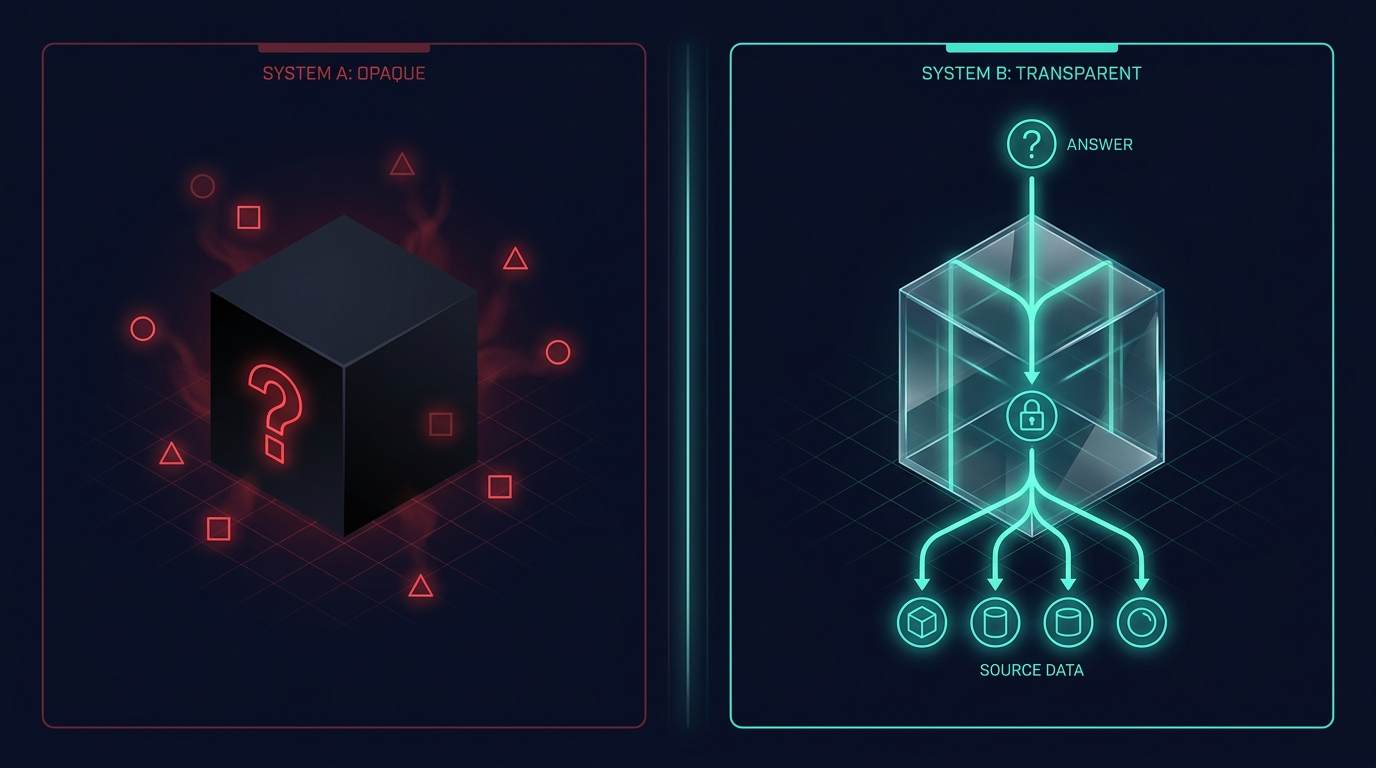
An explanation describes the model's reasoning. Provenance records the facts. In a regulated setting, the second is what holds up when an examiner asks you to prove an answer rather than narrate it.
The staleness cascade
AI answers are only as current as the documents behind them. When a policy is updated but the AI keeps citing the retired version, a convincing explanation makes the wrong answer more persuasive, not less. This staleness cascade is invisible to feature-attribution tools, because they explain the model, not the freshness of its evidence.
Access you cannot prove
Explainability rarely captures who was allowed to see the source material. If an AI surfaces a restricted document to an unauthorized user, an explanation of the model's logic will not satisfy a data-protection auditor. Attribute-based access control (ABAC) enforced at the AI layer decides, per answer, what each user is cleared to retrieve, and records that decision.
How to Build Explainable AI You Can Defend
Capture provenance at answer time
Log the exact sources, document versions, and retrieval context for every response as it is generated, not reconstructed later. Sovrinty records this immutable per-answer trail as the Golden Spike audit trail, so any output can be traced back to the evidence and permissions that produced it. Verbatim enforcement keeps the answer tied to the cited source instead of paraphrasing it into drift.

Enforce access and keep data in place
Pair explanations with zero-exfiltration retrieval, so source content is never copied into an external model, and with ABAC that scopes every retrieval to the user's clearance. Because the approach is bring-your-own-model, you can switch or upgrade the underlying model without losing the provenance record that regulated teams are actually asked to produce.
Explainable AI and the EU AI Act
The EU AI Act requires high-risk AI systems to be transparent and traceable, with record-keeping that lets authorities reconstruct how a system reached an outcome, and penalties reach EUR 35 million or 7 percent of global turnover. Explainability contributes to the transparency obligation, but the record-keeping and traceability requirements are provenance requirements. The NIST AI Risk Management Framework points the same direction, treating traceability and documentation as core to trustworthy AI. Teams that treat explainability and provenance as one system, rather than bolting an explanation onto an opaque pipeline, are the ones that pass an audit without a scramble.
If your AI needs to produce answers your business can prove, explainability is only half the work. Provenance is the other half. Book a Sovrinty demo to see the Golden Spike audit trail turn an AI answer into evidence you can defend.
FAQ
Common questions
What is explainable AI?
Explainable AI (XAI) is a set of techniques that make an AI system's outputs understandable to people by showing which inputs and logic produced a result. It helps humans review, trust, and challenge model decisions, which matters most in high-stakes, regulated settings.
Is explainable AI required by the EU AI Act?
The EU AI Act requires high-risk AI systems to be transparent and traceable, so explainability supports the transparency obligation. The record-keeping and traceability requirements, however, are provenance obligations that go beyond explaining model logic.
What is the difference between explainable AI and data provenance?
Explainable AI describes why a model produced an output, while data provenance records where the answer's sources came from, which version they were, and who was authorized to see them. Regulated audits usually turn on provenance.
Why is explainable AI not enough for regulated industries?
Because an explanation can be plausible yet unverifiable. Regulators ask for proof of the exact sources, document versions, and access permissions behind an answer, which is provenance rather than explanation.
How do you make AI answers auditable?
Capture the exact sources, document versions, and access decisions for every answer as it is generated, not after the fact. Sovrinty's Golden Spike audit trail creates this immutable per-answer record so each output can be traced to its evidence.


