
Grounded AI is an approach where every model response is anchored to specific, verified source content and cannot assert facts beyond it. Instead of generating fluent guesses, a grounded system retrieves approved material, answers from it, and records which source produced each claim, so the answer can be checked, audited, and defended.
| DIMENSION | UNGROUNDED LLM | GROUNDED AI |
|---|---|---|
| Source of answer | Trained parameters and guesswork | Retrieved, approved source content |
| Hallucination risk | High; fabricates plausible text | Low; bounded to verified material |
| Auditability | None; no record of why | Per-answer trail to each source |
| Compliance readiness | Hard to defend to regulators | Evidence regulators can inspect |
| Best fit | Low-stakes drafting | Regulated, high-stakes decisions |
Why grounded AI matters for regulated industries
For teams in defense, financial services, and healthcare, a confident but wrong answer is not a minor glitch; it is a liability, a failed audit, or a breach. Generative models are fluent by design, which means they produce plausible text whether or not it is true. That gap between plausible and correct is exactly what regulators, auditors, and risk officers cannot accept. Grounded AI closes it by refusing to answer beyond what approved sources support.
The business case is stark. Gartner forecasts that 60% of enterprise AI projects will be abandoned through 2026 for lack of AI-ready data, and under the EU AI Act, penalties for noncompliance reach EUR 35M or 7% of global turnover. Frameworks like the NIST AI Risk Management Framework and the EU AI Act now expect organizations to show, not just assert, that an AI system behaves as claimed. You cannot demonstrate that without grounding.
The cost of ungrounded answers
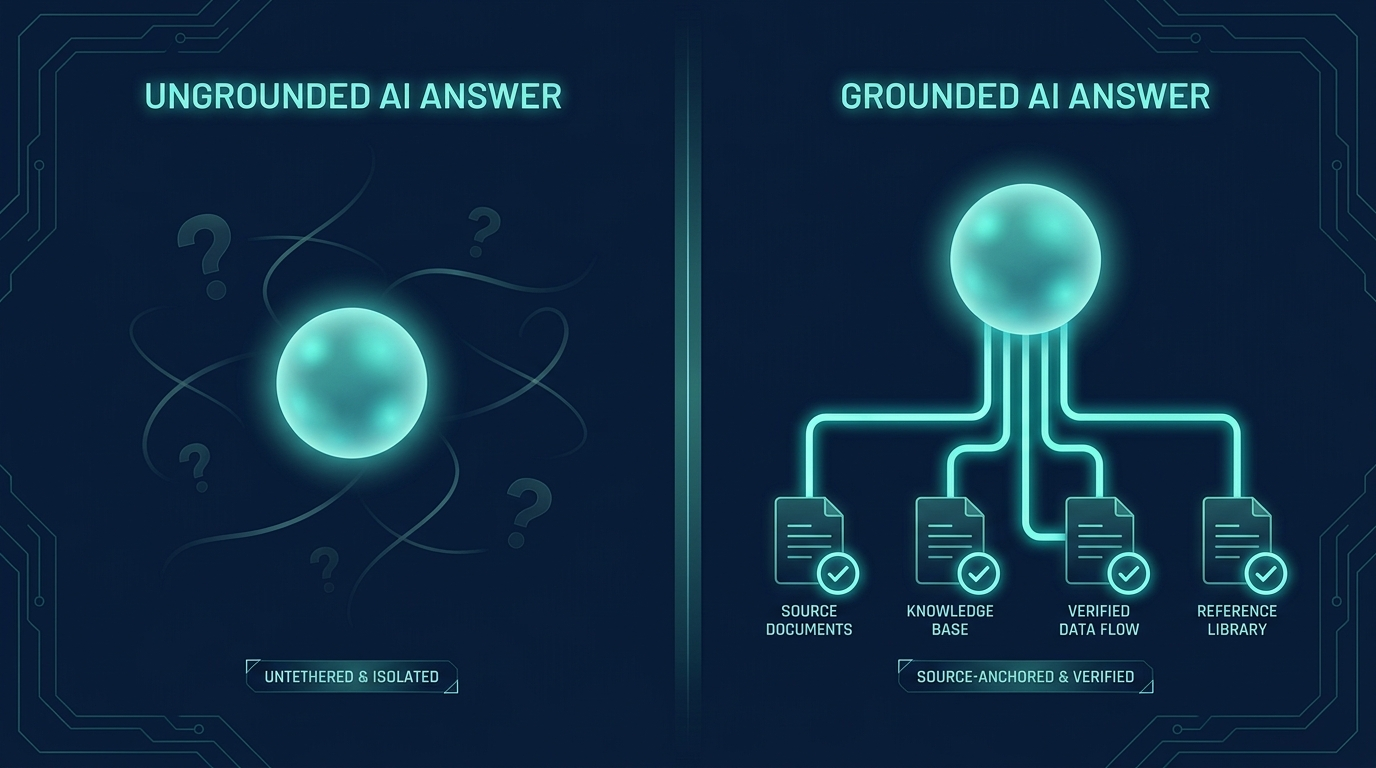
An ungrounded model draws from its trained parameters, blending patterns into a single answer with no record of where any part came from. When a customer, examiner, or court asks why the system said what it said, there is nothing to show. The answer might be right; it just cannot be proven right, and in a regulated setting an unprovable answer carries much of the same risk as a wrong one.
From plausible to provable
Grounding changes the output from a claim into evidence. Every statement traces back to a specific passage in an approved document, so a reviewer can open the source and confirm it in seconds. This is the difference between an assistant that sounds authoritative and one whose answers your business can prove.
How grounded AI works
Grounding is not a single feature; it is a chain of controls that together keep a model tethered to trusted content.
Retrieval from approved sources
A grounded system answers only from a sanctioned knowledge base, not the open web or a model's memory. Access is enforced with attribute-based access control (ABAC) at the AI layer, so a user only ever receives answers built from content they are cleared to see. That keeps grounding and permissions in lockstep instead of bolting security on afterward.
Verbatim enforcement and provenance
Once the right sources are retrieved, verbatim enforcement keeps the model from paraphrasing approved answers into something subtly different, and a per-answer audit trail records exactly which source produced each response. Sovrinty calls this immutable record the Golden Spike, and it is what turns a live answer into a defensible artifact. You can read more about how provenance works on the Sovrinty product page.
Zero-exfiltration, model-agnostic grounding
Grounding should not force you to hand sensitive content to a third-party model. A zero-exfiltration architecture keeps source data inside your boundary, and a bring-your-own-model (BYOM) approach lets you ground the model you choose without lock-in. See the Sovrinty security overview for how access control and data isolation fit together.

Grounded AI vs RAG: related but not the same
Retrieval-augmented generation (RAG) is a technique for feeding a model relevant documents at query time. It is a building block of grounding, but on its own RAG does not guarantee that the model stays within those documents, enforce who may see what, or leave a record you can audit. Grounded AI adds the governance layer: enforcement, access control, and provenance around retrieval, so the result is not just informed by sources but accountable to them.
Putting grounded AI to work
Start by defining the approved knowledge base and who may access each part of it, then require that every answer cite its source and fail closed when no source supports it. Treat stale content as a first-class risk; a staleness cascade that flags and retires outdated sources keeps grounded answers from quietly going wrong. Done well, grounding is what lets regulated teams move from cautious pilots to production AI they can defend.
See how Sovrinty grounds AI answers in your own governed sources, with provenance and access control built in. Book a demo to see grounded, provable AI on your content.
FAQ
Common questions
What is grounded AI?
Grounded AI is an approach where a model answers only from verified, approved source content and records which source produced each claim, so every answer can be checked and audited.
How is grounded AI different from RAG?
RAG retrieves documents to inform a model, while grounded AI adds enforcement, access control, and a per-answer audit trail so the model stays within those sources and every answer is provable.
Does grounded AI stop hallucinations?
Grounding sharply reduces hallucinations by bounding answers to approved sources and failing closed when no source supports a response, though no method removes all risk entirely.
Why does grounded AI matter for regulated industries?
In defense, financial services, and healthcare, an answer that cannot be traced to a source is a compliance and liability risk; grounded AI gives teams evidence they can show auditors and regulators.
Can I use grounded AI with my own model?
Yes. A bring-your-own-model approach with zero-exfiltration lets you ground the model you choose while keeping source data inside your own boundary.


