
On premise AI is artificial intelligence that runs entirely inside an organization's own infrastructure, in its own data center or private cloud tenancy, rather than on a vendor's shared platform. Prompts, documents and model outputs never leave the controlled environment, which keeps sensitive data under the organization's direct legal and technical control.
| DIMENSION | ON PREMISE AI | PRIVATE CLOUD AI | PUBLIC SAAS AI |
|---|---|---|---|
| Where data sits | Your own facility or hardware | Dedicated tenancy in a hyperscaler region | Vendor multi-tenant environment |
| Who holds the keys | Your security team | Shared, customer-managed keys possible | Vendor, with contractual assurances |
| Model choice | Any open weight or licensed model you can host | Models offered in that region | Whatever the vendor ships |
| Jurisdictional exposure | Single, known jurisdiction | Region specific, subject to parent company law | Often multiple jurisdictions |
| Time to first value | Months, hardware and staffing dependent | Weeks | Days |
| Ongoing cost shape | High fixed capital, low marginal | Mixed | Pure operating expense per seat or token |
| What it does not fix | Ungoverned source content | Ungoverned source content | Ungoverned source content |
Why On Premise AI Moved Back Onto the Roadmap
For most of the last decade, the default enterprise answer to any new software category was software as a service. Search demand tells a different story now. Interest in on premise AI and self hosted large language models has grown by roughly an order of magnitude year over year, and the buyers driving that growth are concentrated in defense, financial services, healthcare and government.
Three forces reversed the default. The first is regulation. The EU AI Act carries penalties of up to EUR 35 million or 7 percent of global turnover, and its documentation obligations assume you can describe exactly what data went into a system and what came out. That is a much harder promise to make when the inference path crosses a boundary you do not control.
The second is model commoditization. Open weight models have closed most of the practical gap on retrieval heavy enterprise work, where the quality of the answer depends far more on the quality of the retrieved evidence than on the raw reasoning ceiling of the model. The third is cost shape. At sustained volume, per token pricing stops looking like a bargain and starts looking like a lease on your own workload.
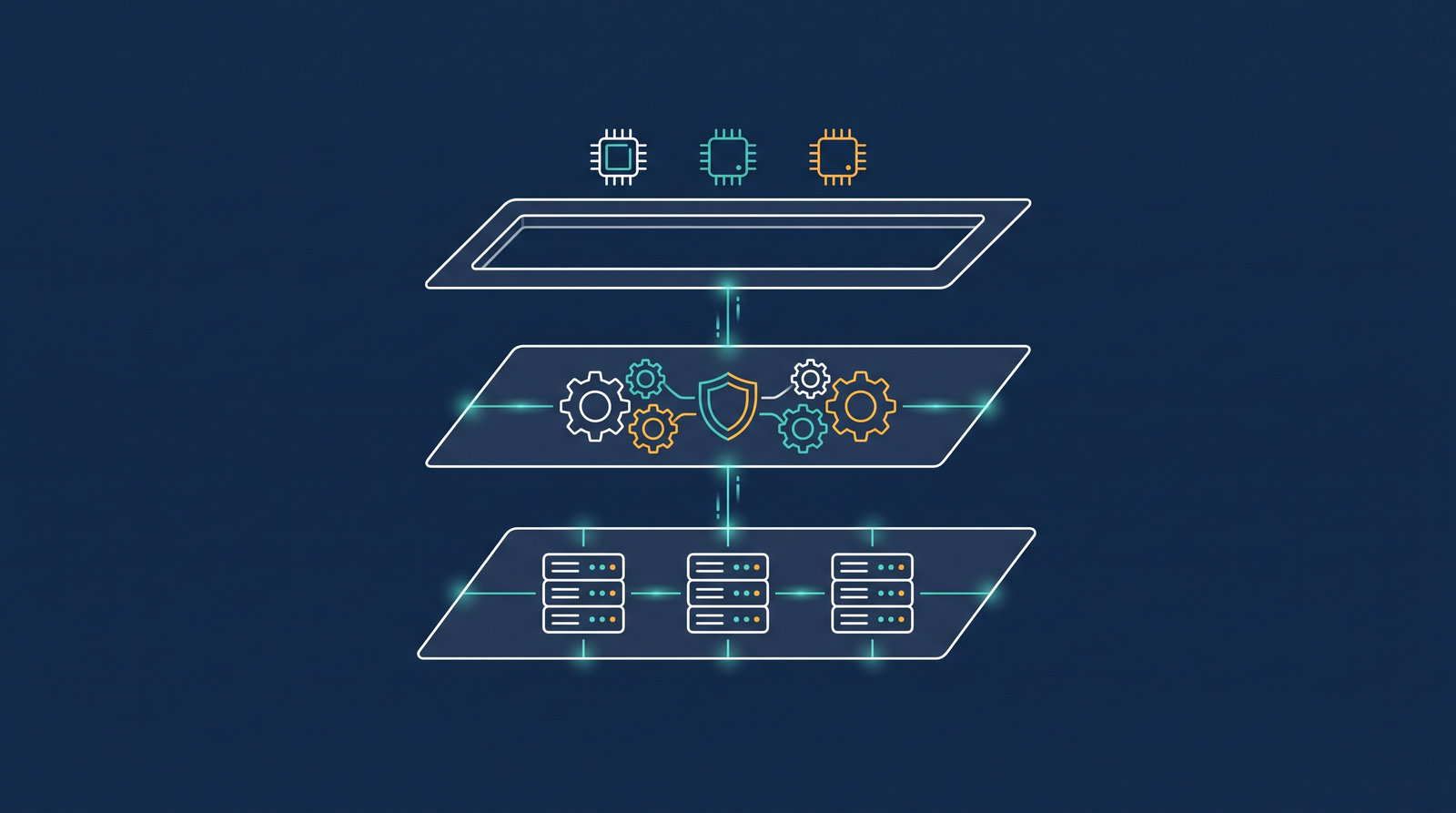
What On Premise AI Actually Solves
Data residency and jurisdictional control
When the model runs inside your perimeter, the residency question answers itself. There is no transfer to assess, no subprocessor list to reconcile, no ambiguity about which country's disclosure law could reach the data. For classified, export controlled or patient identifiable workloads, this is often the only architecture that clears review. Sovrinty treats this as table stakes rather than the headline: zero exfiltration and attribute based access control are the floor, not the product.
Model portability and concentration risk
Hosting your own models turns the model into a component instead of a dependency. A bring your own model architecture lets you swap the underlying model when a better one ships, when a licence changes, or when a regulator asks you to demonstrate that no single vendor can unilaterally alter how your systems behave. The governance layer stays constant while the model underneath it changes.
Auditability of the full stack
The NIST AI Risk Management Framework asks organizations to map, measure and manage risk across the full AI lifecycle. Owning the stack means the logs, the retrieval index, the model weights and the access decisions are all evidence you can produce yourself, on your own retention schedule, without a vendor support ticket standing between you and an auditor.
What On Premise AI Does Not Solve
This is where most on premise AI programmes quietly go wrong. Infrastructure location is a security control, not a correctness control. Moving the model behind your firewall changes who can see the answer. It does nothing about whether the answer is right.
A privately hosted model retrieving over an unmanaged document repository will still surface a policy that was superseded eighteen months ago, still blend an approved clause with an unapproved one, and still present all of it in the same confident register. The failure mode has not been removed. It has been moved inside the building, where it is harder to blame on anyone else.
This is the same trap behind Gartner's forecast that through 2026, organizations will abandon 60 percent of AI projects unsupported by AI ready data. Note the qualifier: the prediction is not that most AI projects fail outright, it is that projects built on data nobody has governed are the ones that get written off. The model being hosted in the wrong place is not what kills them. Nobody being able to vouch for what the model was reading is.

How to Evaluate an On Premise AI Deployment
1. Define the control boundary before the hardware
Write down exactly which components must sit inside the boundary: the model, the embedding service, the vector index, the logs, the evaluation harness. Many deployments marketed as on premise leave telemetry or embeddings outside it. Ask for the network diagram, not the datasheet.
2. Govern the knowledge, not just the model
Decide who approves a source document, how long that approval is valid, and what happens when it lapses. In a governed knowledge layer, answers are assembled only from approved sources, sentences that cannot be traced to one are removed before the answer is served, and knowledge that has passed its review date is pulled from circulation automatically rather than waiting for someone to notice. Content hashes surface drift when an underlying source changes, and stewards record when one document supersedes another, so citations carry a stale flag instead of quiet confidence.
3. Make the answer defensible to an auditor
The test is not whether the system sounds authoritative. It is whether, six months later, you can show which approved sources produced a given answer, who approved them, and whether they were current at the time. ISO 42001 formalises this expectation as a management system requirement, and it is the requirement most on premise pilots are least prepared for.
4. Price the operating model, not just the servers
Hardware is the visible cost. The recurring costs are the people who patch it, the reviewers who keep the approved corpus current, and the evaluation work that proves quality has not regressed after a model swap. A deployment that budgets for the first and not the second two will drift within two quarters.
On Premise AI Is the Floor, Governance Is the Building
Sovereignty over infrastructure and governance over knowledge are different problems, and solving the first does not solve the second. The organizations getting durable value from on premise AI are the ones that treated private hosting as the entry requirement and then spent their real effort on the layer above it: what the system is allowed to read, what it is allowed to say, and what evidence it leaves behind. That is as true for a defense programme handling controlled information as it is for a bank answering a model risk examiner.
If you are scoping an on premise AI deployment and want to see what a governed knowledge layer adds on top of private hosting, book a Sovrinty demo and we will walk through how answers get sourced, cited and kept current inside your own perimeter.
FAQ
Common questions
What is on premise AI?
On premise AI is AI that runs inside infrastructure the organization owns or fully controls, so prompts, source documents and model outputs never leave that environment. It is chosen most often where data residency, export control or patient confidentiality rules make external processing difficult to justify.
Is on premise AI more secure than cloud AI?
It removes a category of exposure rather than making a system secure by default. On premise AI eliminates third party data transfer and narrows jurisdictional reach, but access control, logging and knowledge governance still have to be built. A poorly governed private deployment can be riskier than a well governed hosted one.
What is the difference between on premise AI and a private LLM?
A private LLM refers to the model itself being dedicated to one organization, which can still be hosted by a vendor in an isolated tenancy. On premise AI refers to where the whole system physically runs. Every on premise deployment uses a private model, but not every private model is on premise.
Does on premise AI prevent hallucinations?
No. Hosting location has no bearing on whether an answer is correct. Reducing unsupported output depends on grounding answers in approved sources, removing sentences that cannot be traced to one, and retiring knowledge once it passes its review date. Those are governance controls that sit above the infrastructure.
How much does on premise AI cost compared to SaaS?
On premise AI shifts spending from per seat or per token operating expense to fixed capital plus staffing. It tends to win on unit economics at sustained high volume and lose on short pilots. The recurring cost that gets underestimated is content stewardship, not hardware.
Which industries are adopting on premise AI fastest?
Defense and government contractors handling controlled information, financial services firms under model risk supervision, and healthcare organizations processing identifiable patient data. All three share the same driver: an obligation to prove where an answer came from, not only that it was produced securely.


